
Faber Alpha Gloss Review
Check Out The Incredible Faber Alpha Gloss Review
If your stone floor has started to look a little tired, Alpha Gloss is the kind of product you go for. One where you want to bring some life back to it without turning the job into a whole cumbersome project. It is a polishing fluid made for natural stone and other compatible hard surfaces. You get a quicker polishing step, a better-looking finish, and a surface that stays cleaner-looking with less effort.
So, what can you really expect from it, and how do you use it well?
What Faber Alpha Gloss Is Designed To Do
Its purpose is to give stone and similar hard surfaces a cleaner, more refined polished finish through a quick machine-worked application. So you use it when a surface needs a boost in visual clarity and shine without moving into a long, complicated polishing process.
By supporting the finishing stage of surface care, it helps you improve the look of the floor while also creating a superficial closure that makes the surface less open to dirt at the top level. And that’s why Faber Alpha Gloss has become a staple in everyday professional maintenance as well as targeted refresh work.
You are working with a polishing aid meant for surfaces such as marble, granite, travertine, limestone, terrazzo, and agglomerates. It is especially helpful when you want a straightforward way to lift the appearance of a treated floor.
Benefits of Faber Alpha Gloss
First is the versatility. Faber Alpha Gloss works across several stone and stone-like surfaces, which gives you more flexibility when one space includes more than one material. That saves time during product selection and makes planning easier when continuity of finish matters.
Then there is the ease of use. After all, you don’t want to spend ages on the finishing process. Things get done fast with this formulation, and the application process is straightforward. You shake the bottle, apply a small amount, buff it across a manageable section, and remove the dry residue once the polishing step is complete. That gives you a method that feels controlled and efficient on site. More on this shortly.
The third benefit is the water-based formula. For you, that means a practical working format, including water clean-up for equipment after application. The Faber Alpha Gloss is a thick liquid, which is why it can be worked methodically during buffing.
The fourth benefit is superficial closure to dirt. That means the polished surface gains a tighter, more finished top layer, which can help reduce how easily dirt settles into the immediate surface profile. This matters because appearance and maintenance are closely linked on stone floors.
Working on Mixed Floors
Mixed floors are one of the clearest reasons to choose Faber Alpha Gloss.
Many interiors combine materials such as marble borders, granite inserts, terrazzo sections, or limestone areas within one continuous space. In settings like hotel lobbies, retail environments, shared residential areas, and feature entrances, that kind of design is common. You still want the whole floor to read as one cared-for surface, even when the material changes from section to section.
A product suited to several compatible surfaces gives you a more joined-up approach. Instead of managing different polishing fluids for each zone, you can work with one solution across the materials we’ve mentioned, provided the surface has been tested first and prepared correctly.
That brings consistency to the job and makes it easier to maintain a balanced finish across the floor.
There are both visual and practical reasons for this. Visually, mixed-material floors can lose harmony when one area responds well to treatment and another is left duller or less refined. Practically, using a product built for varied compatible materials streamlines workflow, reduces mishaps, and supports a more even result.
Faber Alpha Gloss stands out here because that multi-material suitability is part of the product’s core identity.
Which Surfaces Faber Alpha Gloss Can Be Used On
Does your floor, wall, or treated surface sit within this product’s range?
Surface type is only part of the equation. Finish, condition, past treatments, and jobsite variables still matter when you are deciding whether Faber Alpha Gloss is the right match.
We’ve talked about how Faber Alpha Gloss is expressly suited to marble, granite, travertine, limestone and terrazzo. That shows you that the product is aimed at stone and stone-based decorative surfaces where appearance, polish, and day-to-day presentation matter. Each of these materials can benefit from a product that helps refine the finish and support a cleaner polished look, especially in spaces that see regular foot traffic or need a visual refresh.
You can extrapolate from that. Faber Alpha Gloss is designed for surfaces that vary in density, pattern, and structure, yet still sit within the wider world of stone care. Marble and limestone are often chosen for elegance and softness of appearance. Granite tends to bring density and durability. Travertine and terrazzo introduce their own texture and visual character.When one product is named across all of those categories, you can see how flexible it is.
So in addition to those, you can also use this formulation on concrete, honed porcelain tiles, natural stone, concrete-marble agglomerates, resin-marble agglomerates, and resin-quartz agglomerates. Faber Alpha Gloss is meant for users working across varied hard finishes, including mixed floorings where different materials appear within the same space.
What if your surface falls just outside this list? For example, if you are dealing with honed porcelain tiles in one section and stone-based agglomerates in another, Faber Alpha Gloss may still be relevant to your project. The same goes for certain concrete-based and resin-based agglomerates, where a polishing fluid can help bring visual continuity across a mixed-material floor. That’s like when you’re dealing with commercial interiors, entrances, shared residential spaces, and design-led settings where more than one surface finish needs to sit well together.
Always Test First
This is the golden rule of the surface care industry.
Surface types only tell you the material category. They do not tell you the full condition of the structure you’re dealing with. A polished marble floor that has been heavily worn, a limestone surface with residual grime, a terrazzo floor with old maintenance build-up, or an agglomerate that has already been treated with another product can all respond differently during polishing.
Absorbency, surface temperature, finish level, and prior treatments shape the outcome just as much as the base material does.
That is you should test out the Faber Alpha Gloss on a small, unexposed area or spare piece before full application. A patch test helps you check how the surface responds, how evenly the product works, and whether the result matches the finish you want. It also gives you a chance to spot issues linked to heat, moisture, residue, or previous treatments before you commit to the full job.
Meet The Brand Behind Faber Alpha Gloss
Faber Alpha Gloss comes from Faber Surface Care, the specialist surface-care brand of Faber Chimica. Founded in Fabriano, Italy, in 1986, the company has spent decades focused on the care, treatment, and maintenance of building surfaces, especially natural stone and other hard finishes.
Mettle, Proven Over the Decades
When you look at the wider brand, you can see that Faber is built around solving surface-specific problems. It covers different stages of care, from cleaning and restoration to protection and polishing. It also spans different material categories and user needs, which tells you the brand understands that surfaces behave differently depending on composition, finish, wear, and setting. You can see this with how Faber Alpha Gloss is positioned for polished enhancement across more than one material type, rather than for a single narrow application.
Faber groups its products into several lines, including Industrial, Made4Stone, Professional, Showroom, Greentech, Trattamenti, and Faber X. Faber Alpha Gloss sits within the Professional line, which is geared towards advanced and specific solutions for architects, project managers, facility management teams, and restoration specialists.
The product was developed with performance, process, and surface compatibility in mind.
Quality And Reach
The brand also brings a strong quality focus to its product range. With ISO 9001:2015 and ISO 14001:2015 certifications, plus a presence across Europe, the Middle East, and parts of Asia, Faber has experience working across different markets and surface-care demands. So when using the Alpha Gloss treatment, you’re banking on a manufacturer that works with clear standards, understands a wide range of materials and environments, and takes a structured approach to product development and support.
Specialist Focus On Surface Care
Faber is built around one core idea: surfaces need care that matches the material, the finish, and the way the space is used. That is why its work centres on natural stone, ceramic, stoneware, agglomerates, cotto, quartz, and concrete, rather than treating all hard surfaces as if they respond the same way. This specialist focus shapes the whole product philosophy. You see solutions designed for cleaning, polishing, protection, restoration, stain management, and long-term maintenance, all within a clear surface-care workflow.
It’s basically a brand ecosystem that understands how stone and hard finishes age, pick up dirt, lose visual clarity, and respond to treatment. So by going with Faber Alpha Gloss you get a product shaped by material knowledge, site experience, and practical treatment routines.
How Faber Alpha Gloss Works
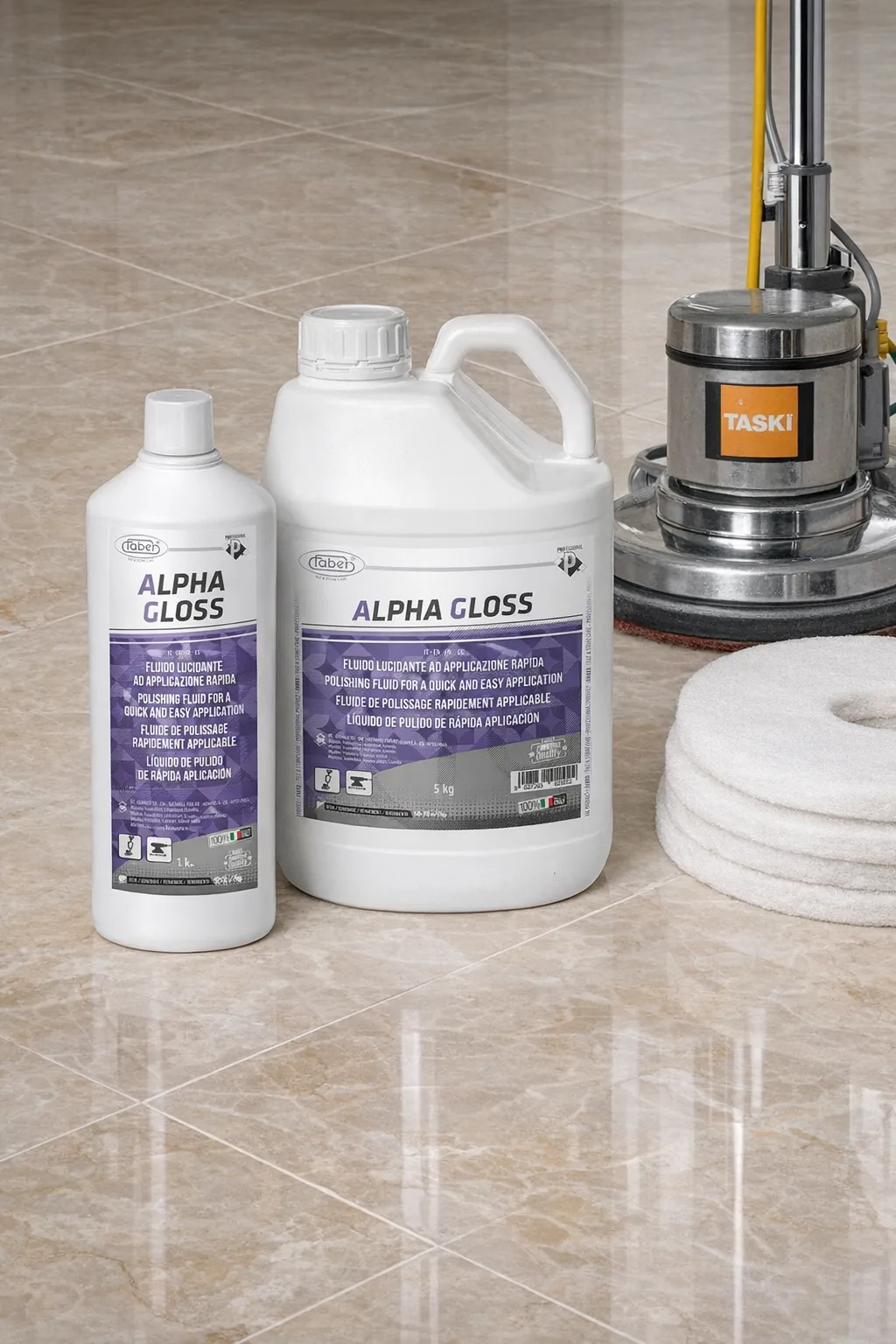
When you use Faber Alpha Gloss, you are working with a fluid designed to improve the surface through a controlled, mechanical process. The product goes onto a clean, dry surface in small sections, then it is buffed with a single-disc machine and a white pad at 150 to 200 rpm.
The result comes from the combination of product, movement, coverage, and surface preparation. You are not simply applying a liquid and waiting for a visual change. You are guiding the product across the surface so it can refine the finish evenly and bring out a clearer, more polished appearance. Plus there’s the superficial closure to dirt. In everyday terms, that means the top of the surface becomes more closed and better finished after treatment, which can help it stay cleaner-looking between maintenance cycles. The Faber Alpha Gloss is especially useful when your surface already has a sound base and needs polishing support rather than major corrective work.
A Water-Based Formulation
The water-based formula shapes how Faber Alpha Gloss behaves from the moment you start working with it. First, it gives you a product that is easier to manage during application because it spreads in a fluid, workable way once the bottle is shaken and the consistency is restored. It is a thick liquid, which fits the kind of controlled buffing needed for section-by-section polishing. That consistency helps you place the product where you need it and work it evenly across the floor.
This also aids after the polishing stage. Equipment can be washed with water at the end of the job, which makes clean-up simpler and more straightforward on site. If you are handling regular maintenance work or polishing larger areas, that kind of practical ease makes a difference. It supports a smoother workflow from application through to pack-up.
What “Superficial Closure To Dirt” Means For You
The idea is fairly easy to understand once you connect it to everyday use.
When a surface is polished well, the uppermost layer looks more refined and feels more finished. Faber Alpha Gloss is designed to support that kind of surface improvement. As the product is buffed across the floor, it helps create a tighter, cleaner-looking top surface, which in turn can make routine dirt less quick to settle into the immediate surface texture.
And you want this for day-to-day protection.
A surface with better superficial closure usually presents better between cleaning cycles. Dust, light soil, and everyday marks tend to sit more on the surface rather than visually dragging down the finish right away. In busy interiors, that can help polished floors hold onto their cared-for look for longer.
Moreover, the polishing step and the maintenance processes are linked. Faber Alpha Gloss pairs with daily and heavy-duty cleaning products according to material type and dirt conditions. In other words, a better finished top layer supports easier ongoing care.
What Kind Of Result You Should Expect
Right off the bat, you’ll get visible improvement in polish, surface clarity, and finish quality. On a suitable surface that has been cleaned properly and treated with the correct machine action, the floor should look brighter, more even, and more refined.
Repeating the application can help you achieve a higher shine or stronger superficial closure, which gives you some flexibility depending on the look you are aiming for.
Keep in mind that Faber Alpha Gloss works best when the surface already has a solid structural base, where you just need to give it polishing support. If the floor has lost visual sharpness through wear, dullness, or day-to-day traffic, this product can help restore a fresher presentation. In such a case, you’re after refinement, gloss improvement, and surface finishing rather than total transformation. That is where Faber Alpha Gloss delivers its value. It helps a suitable surface look better cared for and better prepared for daily use.
What Faber Alpha Gloss Does NOT Replace
The product has a specific place in surface care. It serves as a polishing aid and finish improver for compatible materials. That means deeper structural issues still call for the right corrective process for the job. Surfaces with major wear, deep etching, significant damage, or treatment needs beyond polishing benefit from more intensive restoration, repair, or sealing work according to their condition and material type.
So keep Faber Alpha Gloss within that polishing role (buffing, shine, superficial closure, and maintenance follow-up). Use Faber Alpha Gloss when your goal is to refine and improve the surface finish of a sound, compatible material through a quick and controlled polishing process.
How To Apply Faber Alpha Gloss Step-by-Step
If you give the surface the right conditions, the right preparation, and the right machine movement, you give the product the best chance to deliver a clean, polished finish.
Small details matter: surface dryness, working temperature, section size and even the choice of pad.
What You Need Before You Start
First make sure the surface is dry and clean. A damp floor, overheated surface, or recently installed area that has not fully cured can affect how evenly the product works and how well the finish develops.
You also need to protect any nearby surfaces that are not being treated. The last thing you want is unnecessary clean-up afterwards. In terms of equipment, you will need a single-disc machine with at least 2.0 HP or a manual polishing machine. For the polishing step itself, the machine should be fitted with a white pad and operated at 150 to 200 rpm.
And remember, before full use, test the product in a small unexposed area or on a spare piece so you can confirm that the surface responds well.
Surface Preparation
If dust, grit, or everyday dirt are still sitting on the surface, they can get in the way of the pad and make the finish look uneven. That is why preparation matters so much.
Start by clearing away loose dirt, dust, and any surface contamination. You want Faber Alpha Gloss to work directly on the material itself, not through a layer of build-up. When the surface is properly cleaned first, the buffing stage feels more controlled and the finish is much more likely to come out even and polished rather than patchy.
This is also the point where you take a closer look at the floor.
Make sure the surface is fully dry, check for any obvious problem areas, and see whether nearby finishes need protecting before you start. Once everything is clean, dry, and ready, you can move into the polishing stage with much more confidence.
Application Method
You will get the best result when you work in small, manageable sections. A good area to focus on is about 1 square metre at a time. That gives you better control over how the product spreads, lets you watch how the surface responds, and helps you keep the finish even from one section to the next. When you try to cover too much floor at once, it becomes much harder to keep the result consistent.
Start by shaking the bottle well so the product returns to the right fluid consistency.
Once it is ready, place about a spoonful of Faber Alpha Gloss onto the first section. You only need a measured amount to get started, so there is no need to overload the surface.
Then buff the product with a single-disc machine fitted with a white pad, keeping the speed at 150 to 200 rpm.
Work in circular motions and focus on spreading the product evenly across the whole section. When you keep the movement steady, you help the surface develop a smoother, more balanced finish.As you move through the area, slightly widen your passes into the next section. That little overlap helps each section blend into the next, so the floor looks more continuous overall.
Keep the pad moving, work at a steady pace, and let the polishing action build gradually. As you finish each section, you should start to see the surface looking clearer and more polished.
Dealing Residue (And Repeating If Needed)
Once a section has been polished, remove the dry residues before moving on. You can do that with a cloth, a broom, or a vacuum cleaner, depending on the area and the scale of the job. The key point is to clear the surface thoroughly so you can properly judge the finish and keep the work area clean as you go. Residue left behind can dull the visual result and make the area feel unfinished.
For a stronger level of shine or a better superficial closure, repeat the application. A second pass can be useful when the floor needs a little more visual lift or when you want a more complete polished effect. Because the product does not create layering defects, you can approach that second application with confidence as long as the first pass has been handled properly and the surface is suitable.
When The Surface Can Go Back Into Use
Once the polishing is complete and the residues have been removed carefully, rinse the surface with water. After that, you can allow normal foot traffic back onto the area. The formulation leaves the treated area clean, clear, and ready for day-to-day activity.
At the end of the job, wash the equipment with water as well. That keeps your machine and accessories ready for future use and makes the overall process easier to manage from start to finish.
Coverage Factor
Now to estimate how much product you may need, what kind of consistency you will be working with, how the product is likely to behave during application, and how to store and handle it properly once the job is done..
What You Get From Each Package
Faber Alpha Gloss has a coverage of 50 to 70 square metres per kilogram. That gives a helpful starting point when estimating product quantity. The final coverage will vary depending on:
- the condition of the surface,
- how absorbent it is,
- how evenly the product is worked, and;
- whether you choose to repeat the application for extra shine or stronger superficial closure.
Still, that range is useful for planning labour, product ordering, and overall job flow.
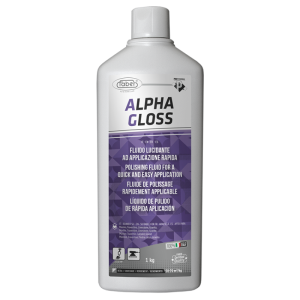
Your options are also straightforward. Faber Alpha Gloss comes in:
- a 1 kg bottle, packed 12 bottles per box
- a 5 kg bottle, packed 4 bottles per box.
Smaller bottles suit lighter jobs, testing phases, or lower-volume use. Larger bottles make more sense when you are covering broader floor areas or managing product supply for regular work.
Physical And Chemical Nature Of The Product
Faber Alpha Gloss is a thick liquid, which matters because consistency affects control. A thicker fluid gives you a product that can be placed and worked across the surface in a measured way during machine polishing. It supports even distribution and helps keep the application process steady from one section to the next.
The product is light blue in colour and unscented. Those points may seem minor, but it’s to help you understand what to expect once the bottle is open and the job begins. A visible colour can make handling easier during application, while an unscented product keeps the working environment more neutral, especially indoors or in enclosed spaces.
Its pH is 3.2 ± 0.6. That’s a mildly acidic product profile, which is relevant when matching the product to suitable materials and following the intended application method carefully. It reinforces why surface suitability, preparation, and testing all matter before full use.
Storage, Shelf Life, And Equipment Cleaning
Faber Alpha Gloss should be kept tightly closed and stored in a cool, dry place. That preserves product quality between uses and supports consistency over time. The shelf life is 24 months in the original sealed packaging, which gives you a practical window for storage and inventory planning.
After application, the equipment can be cleaned. That keeps the end of the job simple and makes routine maintenance easier for your machines and accessories.
Maintenance After Using Faber Alpha Gloss
Once you have taken the time to polish the surface properly, you will want that finish to last. Light, regular cleaning helps the surface stay fresh and polished-looking. Stronger cleaning has its place too, especially when the floor is dealing with more than everyday dust, marks, and traffic film.
So treat routine care and deeper cleaning as two different jobs to give the surface a better chance of keeping its polished appearance over time.
Daily Maintenance
For day-to-day care, use ALGAFLOOR or NEUGEL, depending on the material. They will support the Alpha Gloss finish, keeping it looking clean and well cared for instead of gradually losing its clarity due to grime building up.
The cleaner needs to suit the material itself. Marble, granite, limestone, terrazzo, and agglomerates each have their own character, and over time they can respond differently to wear and cleaning. Choosing the right maintenance product helps you care for the surface in a way that makes sense for that specific floor.
Heavy-Duty Cleaning When Needed
Some surfaces eventually need more than routine maintenance. In those cases, go for the FABER 30 or DETERFUG. Pick them based on the kind of dirt present and the material being cleaned.
Heavy-duty cleaning should be purposeful. You only go this route when the floor needs a stronger reset. Daily maintenance is enough for ordinary care. Matching the cleaner to the dirt and the surface helps you clean thoroughly without taking a rough, one-method-fits-all approach.
How Good Maintenance Protects The Finish
For one, you reduce the build-up that gradually makes a surface look tired. When dust, grime, and residue are removed regularly, the polished finish stays clearer and more readable. When cleaning is delayed or handled poorly, the floor can lose that fresh, refined look sooner.
You get the best long-term result by keeping the routine steady, using the right cleaner for the level of dirt, and responding before build-up becomes heavy. That kind of care helps the finish stay more consistent from one maintenance cycle to the next.
Best Practices When Using Faber Alpha Gloss
You get optimal results when you respect the conditions around the product as much as the product itself.
- Start with dryness. The surface needs to be fully dry before application. Moisture interferes with how the polishing fluid spreads and how evenly it works during buffing. A damp substrate can also trap issues below the surface, which makes the result harder to control.
- Work within the recommended temperature ranges of +5°C to +40°C. If the material is overly heated, the product can become harder to manage during application, especially when you are trying to keep coverage even across each section.
- Freshly laid or newly grouted floors need a bit of patience. Before you move on to polishing, give the adhesive or grout enough time to cure fully. That allows the surface to settle properly and helps you work on a floor that is stable and ready for treatment.
- Finally, protect yourself and the surrounding area. Use suitable personal protective equipment, shield adjacent untreated surfaces, and keep the work zone controlled from start to finish.
0 Comments
Questions or feedback? Join the discussion below.
No comments yet. Be the first to comment.
Replying to