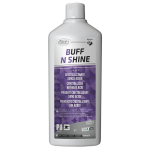

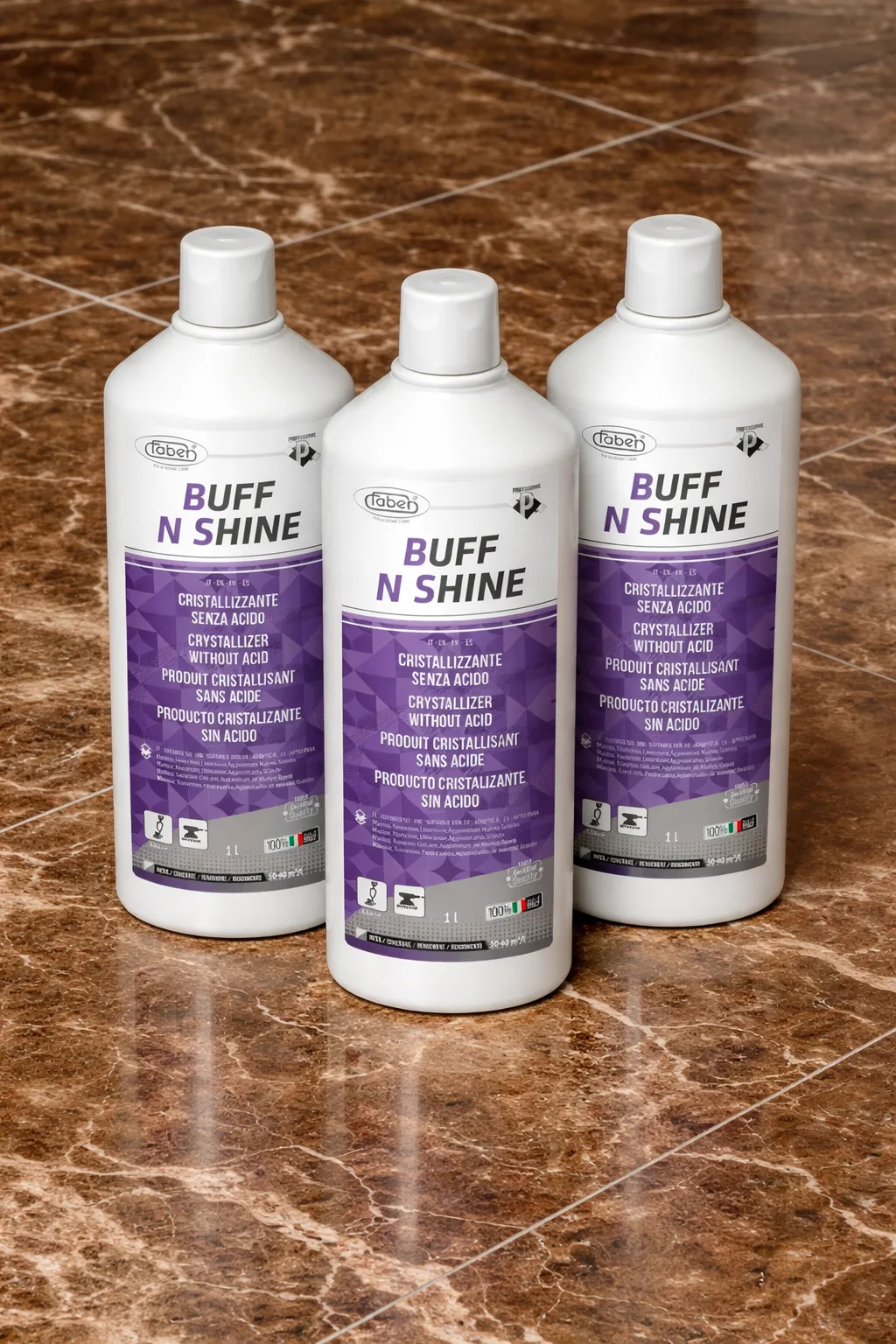
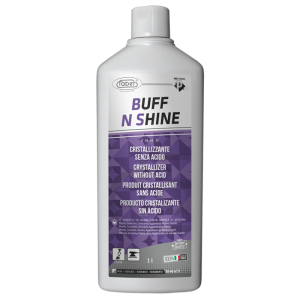
Faber BUFF N SHINE Polishing Cream
Faber BUFF N SHINE Polishing Cream for Smarter Stone Surface Maintenance
Some surfaces change so gradually that you only realise it when the whole space starts to feel different. The lobby looks less sharp. The hallway feels duller. The polished floor that once lifted the room now blends into the background. Light simply does not hit it the same way. It all looks ‘tired’.
A polished surface shapes the mood of a room. It reflects light, adds depth, and gives the space that clean, cared-for look you notice straight away. Then everyday life takes over. Foot traffic builds. Cleaning becomes routine. Over time, the sharpness softens, and the surface loses some of the presence it once had.
When that happens, you start looking for a way to bring back that original feel. Faber BUFF N SHINE Polishing Cream is one of the products designed for exactly that kind of finish maintenance. In this guide, we will look at where it fits, and what you should know before using it.
Benefits Of Faber BUFF N SHINE Polishing Cream
BUFF N SHINE is a water-based crystallizer created for natural stone and related hard surfaces that already have a polished finish. You use it when shine has started to look a little tired and you want to refresh that polished appearance with a controlled polishing step. Its job is to support and revive surface brightness, help the finish look cleaner and more refined, and do that in a format designed for regular professional maintenance rather than a long, multi-stage intervention.
The main strengths of Faber BUFF N SHINE Polishing Cream are in day-to-day surface care. You are working with a product designed to maintain shine on polished surfaces quickly, with a formula that is easy to manage across several compatible materials.
Acid-Free Positioning
When you are working on materials such as marble, limestone, and travertine, finish quality and surface appearance need careful handling. Acid-free nature of the formulation delivers a gentler touch for your surfaces. This enables controlled polishing, surface clarity, and repeatable shine upkeep.
Note that Faber BUFF N SHINE POLISHING CREAM is intended to preserve the look of a surface that already has a polished base, not create a polished finish from scratch. If the stone already presents well and your goal is to restore clarity, brightness, and a more even polished look, Faber BUFF N SHINE Polishing Cream fits that. It gives you a targeted way to keep polished surfaces looking alive without moving into a heavier restoration workflow.
Quick And Easy Shine Maintenance
Time is often a real constraint in surface care. You may be maintaining a hotel floor, a commercial entrance, a staircase, or a residential stone surface that needs to look polished again without taking up an entire day. Faber BUFF N SHINE Polishing Cream is designed for exactly that kind of job. It is applied in small sections, worked with a single-disc machine or manual polishing machine, and can be repeated if you want a higher shine or more superficial closure. That gives you a faster maintenance route when the surface already has a polished base and only needs its finish refreshed.
Water-Based Formula
You want a straightforward working experience. The water-based formulation affects how the product handles the surface, how it behaves under the machine, and how you clean up once the job is done. The creamy consistency of the product makes it a breeze to use.
Even equipment gets to benefit. Faber BUFF N SHINE Polishing Cream is washed with water after application, which helps keep the process more manageable on site. For you, that means fewer complications during setup and pack-down, especially when you are maintaining polished floors as part of routine professional care rather than a one-off specialist intervention.
High Compatibility Across Multiple Materials
It’s very likely that your space includes more than one surface type. Faber BUFF N SHINE Polishing Cream is suitable for the likes of marble, granite and travertine, limestone, terrazzo, right through to resin-based agglomerates. So you won’t keep looking for different products for the same task.
That wider reach simplifies maintenance planning in mixed-material interiors because you can use one polishing-maintenance product across several compatible polished surfaces instead of breaking the job into multiple separate systems.
We’ll look at more of the surfaces shortly.
From A Powerful Brand
Faber Chimica has been working in surface care since 1986, when the company was established in Fabriano, Italy. From the beginning, it focused on professional chemical solutions for the care, treatment, and maintenance of building surfaces such as marble, granite, ceramic, stoneware, agglomerates, and terracotta. That’s the backdrop that resulted in BUFF N SHINE POLISHING CREAM. You get a product from a brand built around surfaces as a complete system, from treatment and restoration to polishing and day-to-day care.
One core strength of Faber is the way it works across the whole life of a surface. The brand develops solutions for industrial production, professional site work, and home maintenance, so it approaches surfaces before installation, during project work, and throughout daily use. Its range is organised into distinct product lines for Professional, Showroom, Green_tech, Treatment, and Industrial use. BUFF N SHINE POLISHING CREAMsits in the Professional line, a product designed for skilled, equipment-led application. It’s also in Faber’s honing and polishing category, being finish-focused.
Faber puts strong emphasis on technical expertise, professionalism, innovation, support, and respect, and it backs that up with services such as technical assistance, training, and private-label work. It also leads in environmentally conscious product development, including LEED-mapped solutions. Its international distribution network has expanded through Singapore in 2001, the UAE in 2016, and Spain in 2023. When you pick up BUFF N SHINE, you are looking at one product inside a specialist surface-care ecosystem with deep technical roots and broad international reach.
Where Faber BUFF N SHINE Polishing Cream Fits In Stone Care Routine
You reach for it after the original polishing work has been done and once everyday use has taken a little clarity or brightness out of the surface. In that position, it functions as a maintenance polish that helps you keep the visual quality of the floor or stone surface at a strong standard without restarting the whole finishing process.
That makes it different from your regular daily maintenance products, which are there to manage routine soil, and different from heavy-duty cleaners, which deal with built-up dirt or more stubborn contamination. It is also different from surface protection products such as sealers, because its role centres on polish upkeep rather than stain resistance or barrier formation. In the same way, it occupies a separate place from grinding, honing, or more corrective polishing systems, which come into play when the surface needs deeper mechanical refinement. Faber BUFF N SHINE Polishing Cream enters the routine when the structure of the finish is already in place and what you want is a cleaner, brighter, more refreshed polished look.
Timing matters here.
This product makes the most sense when the stone has lost some sparkle through use, traffic, and everyday wear, yet still has a sound polished base. Pair it with machine buffing for section-by-section work, and you can also repeat the application for a higher shine or more superficial closure. Used at the right point in the routine, Faber BUFF N SHINE Polishing Cream helps you preserve the value of earlier polishing work and keep polished surfaces looking sharp for longer.
Surfaces Faber BUFF N SHINE Polishing Cream Is Designed For
We’ve talked about how BUFF N SHINE works with a broad mix of polished stone and stone-look surfaces (makes it especially useful when you are caring for spaces that do not rely on a single material). What kind of range are we dealing with?
Marble, Limestone, and Travertine
If you are working with marble, limestone, or travertine, shine maintenance tends to matter a great deal because changes in finish are usually easy to spot. These lime-based stones often feature in floors, stairs, reception spaces, bathrooms, and decorative interiors where light reflection plays a big part in the overall look. Once the polished surface starts to lose crispness, the whole area can appear flatter and a little less cared for. BUFF N SHINE suits these materials well because it is built around maintaining the shine of polished surfaces rather than treating them like basic everyday flooring.
Granite and Other Dense Stone Surfaces
Granite expands the product’s usefulness because it brings denser stone surfaces into the picture. You often find granite beside marble or terrazzo in entrances, commercial floors, counters, lift lobbies, and shared circulation areas. A product that can work across several compatible polished materials gives you a more practical maintenance option when a building uses mixed finishes. That helps you keep visual consistency from one section to the next instead of treating each zone as a completely separate system.
Terrazzo and Agglomerates
Terrazzo and agglomerates come in because many modern interiors rely on composite surfaces that still need the same level of finish care as natural stone. In commercial interiors especially, these materials are chosen for their clean look, repeatable appearance, and design flexibility. Once the polished face begins to look dull, the space can lose some of its sharpness. BUFF N SHINE POLISHING CREAM fits well here because it is compatible with terrazzo and multiple agglomerate categories, including marble-based and resin-based variants.
Other Surfaces
The suitability range also covers concrete, honed porcelain tiles, and other natural stone surfaces, which gives you more flexibility in mixed-material projects. Even with that broad compatibility, surface condition still matters. Finish, porosity, heat, moisture, and previous treatments all affect how a product behaves in practice. That is why you should always test a small, discreet area first before moving across the full surface – especially when you are dealing with older floors, recently treated areas, or surfaces with an uneven maintenance history.
What You Need Before You Start
Before you apply BUFF N SHINE, get the setup right. Good preparation has a direct effect on the finish, the shine level, and the evenness of the result. If you rush this stage, the polishing step becomes harder to control and the surface can end up looking patchy rather than refreshed.
First is the machine.
Faber BUFF N SHINE POLISHING CREAM is designed for use with a single-disc machine with at least 2.0 HP or a manual polishing machine. This product needs active mechanical buffing to work properly. You are not applying it like a simple wipe-on treatment. You are using controlled movement, the right pad, and steady polishing action to refresh the finish.
Next, prepare the surface carefully.
Remove dust, dirt, and loose residue before you begin. Any debris left behind can interfere with the polishing process and reduce clarity across the section you are working on. A clean surface gives you a better chance of achieving an even result from the first pass.
You also need to organise the work area properly. Treat the floor in small sections of 1 to 2 m² at a time so you can control product spread and machine movement. Protect any surrounding surfaces that are not being treated, especially where materials change at edges, thresholds, or borders. That simple step helps you work more cleanly and keeps the finish consistent only where you want it.
Temperature matters as well. Apply Faber BUFF N SHINE Polishing Cream only when the surface is between +5°C and +40°C. Within that range, the product behaves more predictably and is easier to polish evenly. Once your machine, surface, surrounding area, and conditions are ready, you are in a much better position to get a polished result that looks clean, bright, and controlled.
How To Apply BUFF N SHINE Step-by-Step
Proper application comes down to control. You want a clean surface, a measured amount of product, steady buffing, and a consistent approach from one section to the next. When you work methodically, the surface takes on a brighter and more refined polished look without uneven patches or residue left behind.
Step 1: Test A Small Area First
This gives you a chance to see how the finish responds before you move further. It is especially useful when the floor has an unclear maintenance history, mixed finishes, or older treatments. A quick test at the start can save you from repeating the same problem across a much larger area.
Step 2: Work In Small Sections
Once the test area looks right, divide the job into sections of 1 to 2 m². Small sections help you keep product spread even and stop you from chasing drying residue across a large area. They also help you maintain consistent machine pressure and movement. When you work section by section, the finish becomes easier to read and easier to control, which is exactly what you want in a shine-maintenance process.
Step 3: Apply A Small Amount
Shake the bottle well before use. Then place roughly a spoonful of product onto the section you are about to polish. A measured amount works better than flooding the surface. It gives you cleaner machine control and helps the product spread evenly through the area. Starting with a small dose also makes it easier to judge how the surface is responding as you work.
Step 4: Buff With The Right Pad And Speed
Use a single-disc machine fitted with a white pad and run it at 150 to 200 rpm. The buffing stage is what activates the product across the surface. The right pad and the right speed help you maintain a steady polishing action without making the process erratic. Consistency here supports a more uniform shine and a better-looking finish from section to section.
Step 5: Spread Evenly In Circular Motions
Work the product in circular motions, making sure you cover the whole section evenly. As you move, broaden your motion slightly toward the next section. That helps the transition between sections look smoother and more continuous once the whole area is complete. The key is even coverage. When one part of the section gets more attention than another, the finish can look uneven under the light.
Step 6: Remove Dry Residues
After polishing the section, remove the dry residues using a cloth, broom, or vacuum cleaner. Leftover residue can dull the appearance you have just worked to improve. Once residues are cleared and the surface is rinsed with water, the floor can return to use. The product also helps avoid layering defects, which supports a cleaner visual result over repeated maintenance cycles.
Step 7: Repeat If A Higher Shine Is Needed
If you want a stronger shine or more superficial closure, repeat the application. That extra pass can refine the finish further and help the surface present a brighter polished look.
You can stop after the first application when the result already looks right, or build on it when the surface needs a little more lift. Either way, keeping the same careful method from start to finish is what delivers the best outcome.
What Results Can You Expect?
When you use Faber BUFF N SHINE Polishing Cream correctly, you will end up with a polished surface that looks brighter, cleaner, and more visually refined.
The best results come when the stone already has a polished finish and simply needs that finish refreshed. You will usually see the strongest improvement when the surface is still in good condition overall, though the gloss has faded a little through foot traffic, daily wear, or repeated cleaning.
Keep in mind that Faber BUFF N SHINE Polishing Cream is a shine-maintenance treatment, so the final result will depend on the condition of the surface before you begin. If the floor has deep scratches, heavy etching, strong wear patterns, or long-term finish loss, the product can improve the overall look, though some deeper marks may still remain visible. A well-kept polished surface responds more evenly and take on a cleaner, sharper finish than one that has already developed more serious damage.
One advantage is that the finish stays visually cleaner over time because the product doesn’t give layering defects. So don’t be concerned about build-up changing the appearance of the floor after repeated maintenance cycles. You can work toward shine without the surface taking on that coated, uneven, or overloaded look that sometimes worries people with maintenance products.
Your final result also depends on a few basic variables: the type of material, the starting finish, the machine and pad setup, and how evenly you work each section. Faber BUFF N SHINE Polishing Cream is designed for use with a polishing machine, small controlled sections, and circular buffing, so technique has a direct influence on what you see at the end.
When the surface is clean, the product is spread evenly, and the polishing is consistent, the result tends to look clearer, sharper, and more controlled. When the setup or application is uneven, the finish can vary from one section to the next.
Getting More From Faber BUFF N SHINE
If you are planning a job, start with the official coverage rate of 30 to 40 m² per kilogram. That gives you a solid baseline for estimating how much BUFF N SHINE you may need for a floor, stair run, lobby, or other polished stone area. The product comes in 1 kg bottles and 5 kg bottles, which makes it easier to match the pack size to the scale of the work.
Actual coverage can shift depending on the condition of the surface. A smoother, well-kept polished floor usually gives you more predictable yield than a surface with uneven wear or a finish that needs extra attention. Application technique also matters. If you work evenly, section by section, with the right amount of product, planning becomes much easier. If you need a second pass to build a higher shine or more superficial closure, usage will rise accordingly.
For smaller maintenance jobs, a 1 kg bottle may be enough. For broader floor areas or repeated professional use, the 5 kg option gives you a more practical volume to work with. The smartest way to plan is to measure the area first, estimate using the 30 to 40 m²/kg range, and leave a little margin for surface variation and any repeat application.
Important Precautions Before And During Use
These make a big difference to finish quality, control, and safety.
Do Not Apply To A Wet Surface
Moisture interferes with product control. BUFF N SHINE needs a clean, dry surface so it can buff evenly and develop a consistent result across the section you are treating. When the floor is damp, the product becomes harder to manage and the finish can become less uniform.
Avoid Overheated Surfaces
Surface temperature affects how smoothly the product behaves during polishing. As we mentioned, BUFF N SHINE should be used on surfaces between +5°C and +40°C.So don’t apply it when the surface is too hot or cold. Keeping within that range gives you better working control and helps the product spread and buff more evenly.
Wait For New Installations To Cure Fully
If the surface has been recently laid or recently grouted, give the adhesive or grout time to cure completely before application. This protects the finish process and helps avoid problems caused by unstable or still-settling installation conditions.
Protect Nearby Untreated Materials
Because the product is applied in small sections, edges and transitions need attention. Protect nearby untreated surfaces before you begin, especially where stone meets another material or where only part of the floor is being polished. That keeps the work cleaner and helps you confine the finish exactly where you want it.
How To Care For A Surface After Application
Once you have finished polishing with Faber BUFF N SHINE Polishing Cream, your next job is to leave the surface clean and ready for normal use.
Start by removing the dry residues thoroughly. Then rinse the surface with water. Once that is done, the floor can go back into normal use. That makes the process much easier to manage in spaces where you want the polished area looking good again without keeping it out of action for too long.
Good aftercare also helps you hold onto the finish you have just refreshed. A polished surface usually stays looking better for longer when the cleaning routine suits both the material and the level of dirt it faces day to day. That is why Faber BUFF N SHINE Polishing Cream works best as part of an ongoing maintenance routine rather than a one-time shine boost. The aim after application is to keep the surface clean, protect its clarity, and avoid harsh or unsuitable cleaning habits that can wear the finish down again.
- For daily maintenance, the recommended direction is ALGAFLOOR or NEUGEL, depending on the type of material you are caring for. Use Faber BUFF N SHINE Polishing Cream to refresh shine when needed, then support that result with regular cleaning suited to the surface itself. Daily care has a direct effect on how long the polished look holds up between maintenance cycles, especially in busy areas where soil, foot traffic, and routine washing can slowly flatten the finish.
- For heavy-duty cleaning, the recommended route shifts to FABER 30 or DETERFUG, again according to the type of dirt and the material being cleaned. Heavier soil needs a different response from everyday maintenance. If you try to solve every cleaning problem with the same approach, you usually end up either under-cleaning the surface or putting it through unnecessary stress. A sensible aftercare routine keeps each product doing its own job, which leads to a more stable, better-looking finish over time.
Can You Use Faber BUFF N SHINE Polishing Cream For DIY?
BUFF N SHINE sits in Faber’s Professional line, and its application targets people who already work with polishing equipment and understand how polished stone surfaces respond to maintenance treatment. You need a single-disc machine or manual polishing machine, controlled section-by-section work, and the discipline to manage pad choice, speed, residue removal, and surface conditions properly.
That makes the product a strong fit for professional stone-care operators, trained maintenance teams, floor restoration specialists, and experienced contractors who look after polished natural stone and related surfaces. It also makes sense for facilities teams working in hotels, commercial buildings, retail interiors, or high-end residential properties where polished finishes need ongoing visual upkeep. The product rewards good technique, so the best results usually come from users who already understand how to read the surface and adjust their method accordingly.
Sure, you can take it on as a DIY task, but the risks will be higher. The first issue is control. How skilled are you with operating the machinery? It directly affects your movements across the surface, how well you manage each section, and whether you keep the pad working at the right speed. If your movement is inconsistent, the finish can end up looking uneven from one area to the next.
There is also the risk of poor surface prep. Dust, dirt, moisture, or leftover residue can interfere with the polishing process and leave you with a patchy or disappointing finish. On top of that, different materials respond differently based on the condition of the specific installation. A lack of experience makes it harder to judge what the surface needs and how far to go.
Timing can trip you up too. Apply too much product, the finish can turn uneven. Work across sections that are too large, control becomes harder. Leave residues behind, the surface can look dull, streaky, or less polished than you hoped. Temperature matters as well. So do the surrounding surfaces. A rushed setup can cause problems before you even start polishing.
An uneven, streaky, hazy, or patchy result means you may need extra product, more machine time, and in some cases a full corrective polishing step to get the surface back on track. That adds expense quickly, especially if you have already spent money on equipment hire, pads, cleaning products, and your own time. There is also the frustration factor. Instead of refreshing the surface in one controlled process, you end up going back over the same floor trying to figure out what went wrong, where the finish changed, and how to undo it without making it worse.
It’s best left to the pros.
Faber does offer both training and technical assistance alongside its specialist surface-care product lines.
0 Comments
Questions or feedback? Join the discussion below.
No comments yet. Be the first to comment.
Replying to