
Post-installation Restoration With The Faber Acid Cleaner
Post-installation Restoration With The Faber Acid Cleaner
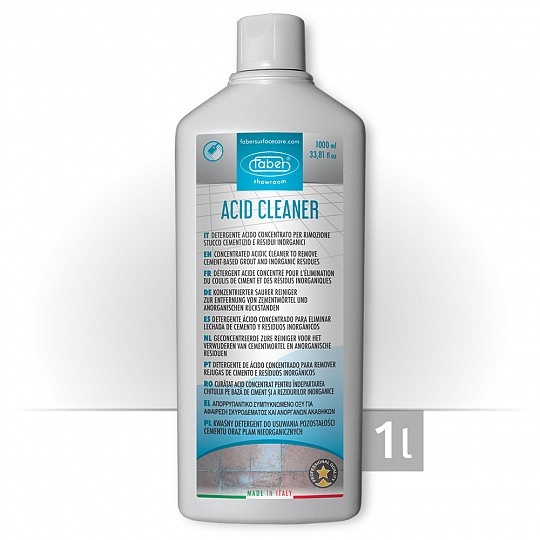
Maintaining your tiled surfaces starts right after the installation. A thorough cleaning is needed to eliminate the residue that accumulated during the process – ranging from the cement and glue, to paint and other kinds of dirt. Without a quality post-installation cleanup, the residue that remains could cause a wide range of problems. Taking care of this at the onset will prevent them from adhering to the surface and becoming troublesome later on. This is for both the interior and exterior surfaces. When the residues become part of the surface, they also discolour it, clashing with the rest of the shade and tone of the surrounding tiles. Moreover, the residues are basically dirt magnets, attracting more dirt to the structure – it may appear minimal at the start, but the soiling quickly compounds, adding to the frustrations. After the grout has fully cured, a powerful cleaning detergent is needed to handle the grime that is on the area. The conventional household cleaners are simply not adept to deal with these kinds of residue. They end up leaving the material behind, which becomes problematic later on. Moreover, it can lead to resource wastage in the attempt to scrub off the material. Turn to formulations that have been developed to handle these kinds of situations – and that’s right up the alley of the Faber Acid Cleaner.
Strong cleaning action
This acid-based detergent packs a punch, and has been particularly been formulated for post-construction clean up. This can be for new buildings, or cases where renovations have been carried out. In such situations where few tiles and other installations have been made, the Faber Acid Cleaner kicks in to clear the glue, varnish, grout residue and other kinds of unwanted substances on the target surfaces. This clears the way for you to continue with the normal day-to-day cleanup in future, without worrying about heavy levels of soiling, as well as cases of surface patina. You also get to ensure that the aesthetics of the newly laid tiles become more prominent, setting the décor that you had aimed for when selecting that particular type of installation.
Due to the high strength nature of the product, it is recommended that you wear personal protective equipment when dealing with it. After all, you don’t want your skin coming into contact with acidic products. Protective gloves and eye protection are highly advised. In case there is an accidental spill of the Faber Acid Cleaner, you can soak up the contents using substances like sawdust, paper towels or vermiculite, after which these contents are disposed of.
Easy to work with
The construction job was already laborious – you don’t want a similar headache when it comes to the cleaning. The Faber Acid Cleaner has been uniquely formulated to lighten the load, making maintaining the surfaces to be a breeze. Simply dilute it, scrub it onto the target area, and give it 5 to 10 minutes for the product to act on the residual matter on the surfaces being worked on. Rinse away all the material and you’re good to go.
For the dilution ratios, you can use 1:2 (1 parts product, 2 parts water) for the areas with stubborn grime, and 1:3 for those situations for the general areas. The concentration of the solution is modified depending on the level of soiling involved. If after the washing there are still bits of residue remaining on the surface, you can proceed to give it another round of cleaning, but this time with a slightly stronger concentration.
The brand has provided an additional range of products that you can use for the surface care after treating it with the Faber Acid Cleaner. Certainly, this will be determined by the particular kind of installation being worked on. For instance, popular brands for the day-to-day cleaning are Faber Neutral Cleaner and Floor installation Cleaner.
When using products from Faber, you can be sure that you’re getting a value return for the money you spend. The brand itself has been making a strong reputation for itself since its conception in 1986. From its headquarters in Italy, the company’s products are now shipped across Europe, the Middle East, to the far-flung regions in Asia. The huge dependence on the brand’s products is due to their proven quality and reliability. Manufacturers processing actual stone slabs, ceramics and porcelain tiles, installers setting them up in buildings, cleaning contractors tasked with providing services in residential and commercial spaces, homeowners carrying out the daily surface cleaning at home, formulations to deal with stubborn stains – they all get solutions from Faber’s wide 250+ catalogue of products. In order to meet the large demand, the company has invested heavily in R&D processes, as well as high-capacity production lines. These economies of scale allow the final cost of the products hitting the shelves to be reduced, to the benefit of the buyer. This can also be seen with the affordable nature of both the 1L and 5L Faber Acid Cleaner options. That way you can get the quantity that will meet your particular post-installation cleanup needs.
Note:
-
For those surfaces that have just been laid or grouted, they should be first allowed to dry and cure before you proceed to wash them with the Faber Acid Cleaner. Ideally, you should wait for around 2 days before proceeding to treat the area with this installation.
-
It is recommended that you sweep or vacuum away the coarse dirt and loose debris that is on the surfaces. This will make the cleanup easier, as opposed to having a case where more gunk goes muddying up the place that you’re washing.
-
The floor can be opened up to traffic immediately after the cleaning.
-
The Faber Acid Cleaner should not be applied onto wet surfaces.
-
As is with any other floor treatment product, if you’re unsure about its suitability for your particular installation you should carry out a spot test on a small, hidden area to observe the impact of the product.
Post-installation Restoration With The Faber Acid Cleaner
0 Comments
Questions or feedback? Join the discussion below.
No comments yet. Be the first to comment.
Replying to