
Floor Care Done Right
Floor Care Done Right
Floor mopping is a routine task. There’s no escaping it. Without proper care, dirt and grime will build up, making the residence or workplace appear chaotic. What’s more, soiling is abrasive, and when left unchecked, it accelerates the wearing down of the surface. Taking care of your floor doesn’t have to be a mundane task. With the right floor cleaning products for your particular installation, the process can be a breeze.
There are basically three categories of supplies that are needed:
-
Equipment to remove the dust and loose debris.
These are the likes of brooms and dustpans, to the vacuum cleaner. For instance, you can use the Dust Pan & Brush Set (Soft) for areas where gentle dusting action is needed, like countertops, furnishings and sequins, and even the computer keyboard. Such units offer you flexibility in getting to areas that would be difficult even with vacuums. The Dust Pan & Brush Set (Stiff) is a heavy duty alternative that comes in handy for those hard jobs. Adding them to your arsenal of cleaning products is also beneficial for those situations where you want to quickly clear residue, without having to haul out and set up a whole vacuum cleaner.
These come in different sizes, shapes and materials. From flat mops that have washable or disposable pads, making them easy to manoeuvre, but can become quite problematic at the corners; to the string and strip mops that will enable you to work on those hard-to-reach areas. For large areas, machines will be needed- such as scrubber dryers.
-
The floor cleaning solutions
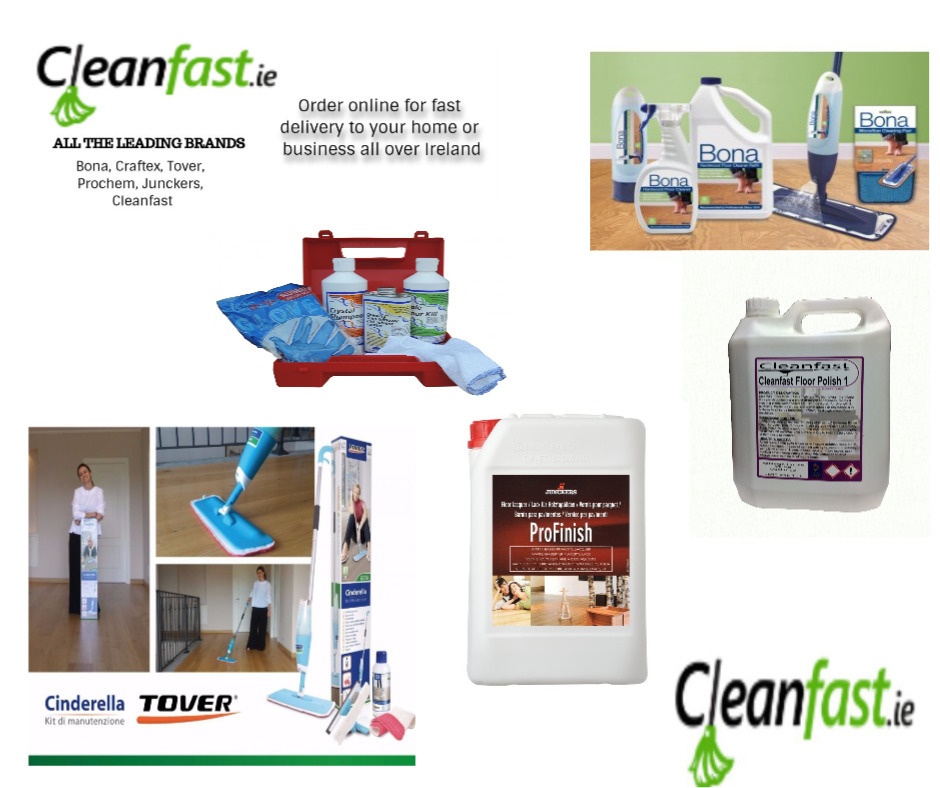
These are diverse, with the chemical formulations of the cleaning products varying based on the target surface to be worked on. For instance, the neutral Cleanfast Mop Shine is suitable across the board- for all kinds of hard and soft floors. From porcelain and wood, ceramic surfaces, terrazzo and linoleum, to terracotta, and laminate floors, you can use it without worrying about the underlying surface being put at risk. The Cleanfast Mop Shine is particularly recommended for commercial floors, where you can even use it with the floor cleaning machines when working on large surface areas to speed up the process. The Cleanfast Multi Shine is also a universal floor cleaner, and in this case, it has the additional benefit of forming a protective coat over the floor’s existing finish, and can even be used to repair damaged and worn out glossy floors.
On the other hand, there are products that are particularly suited for specific types of floors. These are the likes of the Bona Cleaner for oiled floors, and will even get absorbed and bond with the existing finish; or the Bona 5L Hardwood Cleaner that can safely be used on the wood flooring- and can be used manually with mops or with scrubber dryers for those large commercial floors. There are situations where you’ll be dealing with stubborn grime, and require extra power. Here, there are formulations like the alkaline-based Faber Cottosolv 5L, which is a heavy duty degreaser and floor cleaner.
After acquiring the equipment, next is ensuring that is appropriately used.
Mopping Your Floors
Start by preparing the area. Toys, small tables and chairs, and other household goods that are strewn all over the surface should be cleared.
-
Dust the floor, or vacuum it up, to get rid of the dry soiling particles. Brooms and dustpans come in handy for small areas, where you won’t have to lug around the heavy vacuum.
-
Prepare the cleaning solution. Ideally, you should work with warm water, and mix it with the solution based on the ratios that come on the product label. Some of the floor cleaning products come ready to use, and others will be concentrated, requiring them to be diluted. For instance, the Cleanfast Lemon Gel is highly concentrated, and needs to be diluted with a minimum ratio of 1:200 – like 5L of the lemon gel being mixed with 1000L of the cleaning solution. It comes with a neutral pH, and it is used for daily cleaning of highly polished hard surfaces, including terrazzo, linoleum, terracotta, vinyl and marble. Failing to dilute it before use will cause the floor to become sticky.
-
Dip the mop in the bucket with the solution, swirl it around a couple of times, then wring it out. You don’t have to use copious amounts of solution- just a small amount will do. For wood floors specifically, you should absolutely not soak the floor in water. The excess moisture will damage the flooring. For the tiled, cement, vinyl and laminate floors, they can take on more water without damage- but then again going overboard will simply increase your workload, and require you to make more passes with dry mops to soak up the excess water.
-
Start mopping from the furthest corner, away from the door. This is to avoid cases where you walk on areas that have already been cleaned. For the string mops, work in motions of the figure 8, while for those like sponge mops you can work in straight lines.
-
Rinse the mop regularly in the bucket. Note that the water should be changed whenever it becomes too murky or cloudy, otherwise you will simply be spreading dirty water back onto the floor. Speaking of which, there are buckets that have been partitioned, with the cleaning solution being separated from the water used to rinse the mop. This enables you to cover more surface area before the contents of the bucket need to be poured out and replaced.
-
Move towards the door methodically, so as not to find yourself trapped in a corner.
-
Depending on the formulation used, an additional pass may be required over the floor to rinse it. Ensure this is thorough, to prevent residue of detergents remaining behind on the floor.
Allow the floor to dry before letting people enter the room- this is especially for households with kids. This is to avoid slip accidents and to prevent cases of more dirt getting transferred onto the floor, given that when it is wet it will be more likely to hold soiling on the surface- making a mockery of your cleaning efforts. Keep the pets out of the wet areas as well.
Floor Care Done Right
Recommended products
Discover more alternatives and similar items.
-300x300.jpeg)
0 Comments
Questions or feedback? Join the discussion below.
No comments yet. Be the first to comment.
Replying to