
Bona Stone, Tile & Laminate Floor Polish Review
The Impressive Bona Stone, Tile & Laminate Floor Polish Review
Investing in the ideal flooring, such as durable and luxurious stone options, offers various benefits. Marble floors provide unique patterns and colors, while granite’s resilience makes it suitable for indoor and outdoor use. Porous stone floors resist stains and are versatile for wet and dry areas like kitchens and bathrooms. Additionally, travertine tiles are ideal for outdoor spaces, and limestone floors complement both traditional and contemporary décor.
Even with laminate installations, there are different kinds, developed to mimic the various kinds of wood floors like oak, maple, and walnut, to those that have been designed to model tile or stone floors. These artificial installations are more waterproof compared to their alternatives, and less susceptible to dents. Whichever kind of installation you have, you want it to be protected to extend its life, enabling you to derive maximum use from it. Specialised floor care products have been developed for this purpose, and one of the leading formulations in the market is the Bona Stone, Tile & Laminate Floor Polish which we’ll look at here.
Threats To Your Stone, Tile Or Laminate Floor
While they are durable flooring materials, they are susceptible to the wear effects of day-to-day life, making treatments like the Bona Stone, Tile & Laminate Floor Polish a necessity. Let’s delve deeper into the kinds of issues that the floors face and additional measures that you can take to protect them:
Stains
These unsightly spots on the surface take away the floor’s beauty. They can be caused by different issues, the most common being spills. Liquids that wind up on the surface – be they tea, juices, ink blots, or even nail polish, if they aren’t dealt with quickly, seep into the pores of the floors, causing discolouration. Some like coffee and red wine are particularly troublesome.
Etching also causes discolouration. This is particularly due to the acidic liquids that wind up on the floor. ranging from beverages to cleaning products. Here, the acid coming into contact with the surface burns marks into it. These spots are difficult to remove. This is also one of the reasons why it is emphasised that you should only use cleaning agents that are developed for your specific stone or tiled floor.
Water stains, on the other hand, are simply caused by water on the floor remaining in one place for too long – such as when there is a leak or flooding incident. Here, the water stains that are formed are troublesome to remove.
Scratches
Just like other floor surfaces, there is a high likelihood that you will encounter scratches on your stone, tile or laminate floor sooner or later. The scratches are attributed to different things. For instance, the grit and instance dirt particles that are on the surface can get grinded against the floor as people walk on it. This causes scratches to be formed, and at a higher rate when there are high levels of foot traffic in the premises.
The kind of cleaning equipment used also factors in, especially for the scrub brushes and pads. Here, using tools that have tough bristles can end up scratching that natural finish off the stone floor, leaving it rough – which further exposes it to more damage. Instead of such tools, it’s recommended that you work using equipment like soft microfibre clothes when cleaning the floors.
Even the furniture can be a threat to the floors. Those heavy sofa sets have minuscule movements during the day-to-day use. Then there are blunders that can be made like dragging the furniture across the floor when you want to move it, instead of lifting and carrying it.
Wheeled items can also scratch the floor, and this will be largely determined by the wheel material. This cuts across the board, from suitcases, to vacuum cleaners, and wheeled furniture pieces, especially those with wheels that have become worn-out and damaged.
Benefits Of The Bona Stone, Tile & Laminate Floor Polish
-
Bring the shine to your floor
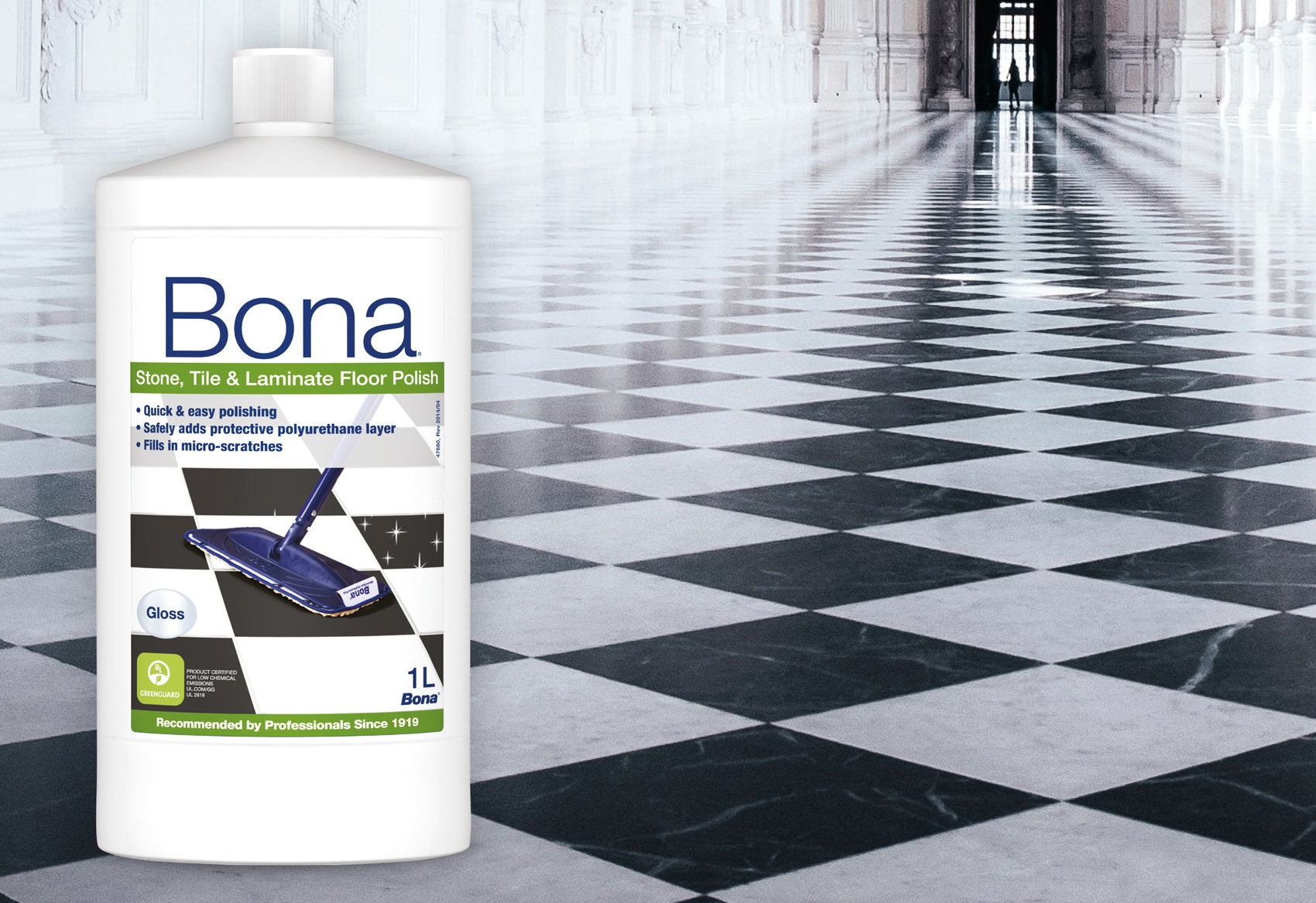
Tired of that dull look on your floor? The waterborne Bona Stone, Tile & Laminate Floor Polish comes in to give it a new shine. This ready-to-use formulation revamps the surface, restoring the charm and appeal to the space. The high gloss effect evens out the appearance of your hard surface floors, giving them a fresh new look. Note that you should always do a spot test on a hidden spot to check for adhesion and the outcome for your particular floor.
With the revitalised floor, you get to enhance the ambience of your interior space. After all, it can be frustrating when you keep coming home to a dull floor, that drags down the ambience of the space. You can have state-of-the-art electronics and furnishings that exude elegance, but when the floor underneath is worse for wear, it is all watered down – which is not what you want after investing heavily in your indoor décor. By enabling you to reverse the state of things, the Bona Stone, Tile & Laminate Floor Polish improves the living conditions in your home, making you proud of the environment that you’re living in, and attracting the admiration of the guests dropping by for a visit.
The aesthetic effect you get from the Bona Stone, Tile & Laminate Floor Polish is also beneficial in commercial spaces. Here, looks have a direct impact on your profits, given that you can either attract or chase off clients based on the condition of the space that they find you in. A dilapidated working environment reflects negatively on your business and brand, since the clients get disinterested in your products or services, as they will have doubts about your claim to professionalism. On the other hand, when they find a well-polished floor whose gloss sparkles up the premises, it creates an inviting environment that further boosts your business image.
-
Increased protection
You also want to enhance the floor’s resistance to daily wear and tear. This for its own structural integrity, as well as preserving that beauty that resulted from the polished surface. You get that with the Bona Stone, Tile & Laminate Floor Polish, where the polyurethane that has been used to reinforce the product adds to the strength attributes of the treatment. This increases the resistance of the polished surface to scratches and scuff marks, in turn prolonging the lifespan of the applied treatment.
The protection provided to the floor – coupled with the opportunity to refresh the floor by carrying out a round of cleaning and polishing, reducing the costs that go into the floor maintenance in future. Speaking of cost savings, the Bona Stone, Tile & Laminate Floor Polish also comes with a pocket-friendly price tag. You even get a wide coverage rate, where 1 litre of the product gets to be used on 50m² of floor surface. This translates to more floor area being worked on with every unit product that’s purchased.
-
Versatile formulation
As you can tell from its name, the Bona Stone, Tile & Laminate Floor Polish has been developed to be used on a wide range of hard surface floors. This also includes vinyl, unglazed tile installations – like ceramic and quarry, all through to sealed marble floors.
When it comes to your floor maintenance budget, the affordable pricing of the Bona Stone, Tile & Laminate Floor Polish is a plus. This, coupled with the wide coverage rate where a litre of the product gets to be used on around 50m² of surface, contributes to reducing the amount of resources that go into the floor care process. Moreover, the additional barrier of protection that the polish provides wards off wear effects and reduces repair costs down the road, bringing you more savings in the long run.
How To Use The Bona Stone, Tile & Laminate Floor Polish
The formulation comes ready to use, so do not dilute it. For the equipment to use, it is recommended that you work with a Bona Applicator Pad. Proceed with these steps:
1. Start by cleaning the floor. Vacuum away the loose dirt and debris, and give the surface a thorough scrub using Bona Stone, Tile & Laminate Cleaner.
2. Allow the floor to dry.
3. Shake the Bona Stone, Tile & Laminate Floor Polish well in its bottle.
4. Pour the polish on the surface – just a wide line on a small portion of the floor. Use the Applicator Pad to spread out the polish over the section.
5. Smooth out the application over the rest of the floor area, working section by section.
6. Since this is a fast-drying product, the area can be opened up to light foot traffic after 2 hours. Heavier traffic, and placing back the furniture and floor coverings, should wait for at least 12 hours.
After the floor treatment, the tools used can be cleaned with water. In case there is dried material, you can remove this with acetone.
A Brand You Can Count On
When it comes to track records, Bona has been making one for over one hundred years. The family-owned company was established in Malmö, Sweden in 1919, and has become an industry heavyweight in matters floor care. It all started when the founder, Wilhelm Edner, decided to maximise the potential of one of the products that was in his grocery store: bonvax.
Applying this agent to wood floors gave them a polished effect, while setting a protective layer on the floor. He went ahead and incorporated the floor care company, and through the course of the 20th century to this very day, Bona has established a strong global presence.
Bona has actually been behind some of the major milestones in the industry. For instance, it was the first company to have a full line of waterborne finishes that were certified safe for indoor air quality. These finishes were introduced in the 1970s, heralding a shift from the solvent-based agents that were predominant at the time. T
he lacquers provided a protective finish without the risks that came with the toxic fumes of solvent-based products. Bona was also amongst the pioneering companies insisting on the switch to dust containment systems which were used during floor sanding processes. These systems collect the fine and coarse sanding dust particles that would otherwise be a health hazard for the persons on the promises.
The brand is big on suitability. For instance, with its first-generation Bona Mega line in 1995, the company introduced floor finishes that were sourced on renewable raw materials. This particular range of products is based on vegetable oils which cross-link on exposure to oxygen, forming a strong coat-delivering, a high performance while having a low impact on the environment. Moreover, with more formulations being released to allow wood floors to be refinished or renovated as opposed to having to replace the actual floor boards, it extends the life of the installation.
This also extends to other flooring materials – such as with the Bona Stone, Tile & Laminate Floor Polish enabling you to refresh the surface once it begins becoming dull. The products from Bona are taken through stringent tests – including third-party chemical emissions standards, to ascertain the safety of their products. For instance, Bona was also the first in the first floor care company in the industry to offer a full system of GREENGUARD Gold certified products.
The numbers also speak for themselves. Bona has established its presence in 90 countries around the world with its 17 international subsidiaries and distributors. From its headquarters in Malmö, Sweden, the company spans to Brazil, Spain and Portugal, the US, United Kingdom, France and Germany, all through to Austria and China.
With 5 factories across the different countries, a workflow of over 600 employees, and raking in sales of 3.1 billion SEK in 2020, there is a clear demand for the products from the brand. They are used across the board, from homes and office buildings, sporting facilities including basketball courts and gymnasiums, all through to busy airports and public spaces. The wide range of products from the brand meet the diverse needs of the floor installers and craftsmen, owners of the home and commercial spaces, all through to contactors such as professional cleaning crews who need quality products to enable them meet their work requirements.
Back to the sustainability efforts. Bona Stone, Tile & Laminate Floor Polish in particular it’s safe according to the requirements of European Regulation (EC) 1272/2008 and its amendments. In addition, it comes with GREENGUARD certification. Let’s expound further on what the certification means for the Bona Stone, Tile & Laminate Floor Polish.
It all comes down to the indoor air quality. When shopping for products like furnishings, mattresses, all through to the floor care products, you may have noticed a GREENGUARD Certification on the product packaging. This is from UL, and proof that the product has gone through vigorous testing to prove that it has low chemical emissions. Products that get this logo are guaranteed to emit very low amounts of volatile organic compounds.
The VOCs are mainly carbon-based chemicals like formaldehyde that evaporate and spread around the indoor air space. They are given off by many different materials, from that mattress in the bedroom, the paint on the walls – all through to that “new car smell” that you detect when you purchase your vehicle. There could be hundreds of VOCs in your premises at any given instance. The higher the concentration of VOCs in the indoor pace, the greater the risk to the persons on the premises.
Remember that the indoor airspace can get up to even five times more polluted than the outdoor air – going by the reports from the Environmental Protection Agency. As such, products used for different cleaning and maintenance tasks in buildings like the Bona Stone, Tile & Laminate Floor Polish are taken through these tests to check levels of emissions.
The GREENGUARD testing is carried out in polished stainless-steel chambers, where the environmental conditions are controlled to ensure that there won’t be background VOCs, and get accurate readings. These dynamic chambers vary in size – with some even being as large as rooms. Different products go here, from insulation material, electronics like laptops, the furniture, as well as the floor maintenance products. The products remain in the chambers for different lengths of time since they have varying emissions rates.
For instance, with the furniture, it can be two weeks since most of the chemicals are off-gassed on the first few days, and the rates go decreasing till the emissions steady after a few weeks. Electronics can only require a day or two, since the emissions are mainly before they are plugged in. During normal operations, they will get hot, and the emissions are measured as the items heat up. The certification process generally takes around six months, and this will be determined by the particular products in question. The testing methods are strict, with the facilities being able to detect over 200 chemicals that can be off-gassed by the product.
Manufacturers voluntarily sign up for the program, which is trusted around the world. You can see thousands of other products on UL’s Sustainable Product Guide that are GREENGUARD Certified. Meeting the requirements of this standard enables you to rest assured that the indoor air quality of the premises you’re working on will be preserved as you treat the surfaces with the Bona Stone, Tile & Laminate Floor Polish.
After you get that charm from your floor, how will you maintain it? The mode of operations used on a day-to-day basis will be a great factor here. Let’s delve into that next.
Taking Care Of Floors Treated With The Bona Stone, Tile & Laminate Floor Polish
Routine cleaning is needed to maintain that lustre for longer. Here you need to work with formulations that will be safe for your floor, not just sloshing any detergent onto the surface and scrubbing away. It is recommended that you use Bona Stone, Tile & Laminate Cleaner, working with the Bona Cleaning Pad. The formulation has been developed for the safe cleaning of sealed hard surface floors – enabling you to scrub away that grime without putting the underlying structure at risk.
Moreover, it emphasises on sustainability, being GREENGUARD GOLD certified – making it safe for environments like schools and day care centuries where there is a need for using products that are a higher degree of safety for the little ones, as they breathe in more air per body weight. Using this particular cleaner, you won’t have to worry about dulling residue remaining behind on the surface – so that shine you get with the Bona Stone, Tile & Laminate Floor Polish gets to be preserved for longer.
To get rid of the dirt, mist the cleaner onto the floor and wipe it off using the Bona Cleaning Pad. For those stubborn spots – like when there are sticky spills that have adhered to the surface, spray the cleaner directly on them and give it a couple of minutes to break down the grime chemically, after which you proceed with the cleaning pad as usual.
Over time, after the area begins showing signs of wear and you want to freshen it up, simply give it a thorough scrub and apply a fresh layer of the Bona Stone, Tile & Laminate Floor Polish. For cases where there is polish build up, you can remove it using the specialised Bona Polish Remover.
Extra Measures To Protect Your Stone, Tile Or Laminate Floor
-
Routine sweeping/vacuuming is needed to clear the dirt and debris particles that are building up on the floor surface. That resultant effect that you got by treating your floor with the Bona Stone, Tile & Laminate Floor Polish will be on the line. The longer that the dirt and debris that are allowed to accumulate, the higher chances that the floor will become dull, due to the wear effects that result from the particles abrading the surface under foot traffic. Sure, the polish is a highly durable formulation, but this does not mean that you ignore the regular care and maintenance that is needed for the floor. In fact, the vacuuming and subsequent cleaning will enable you to enjoy the effects of the Bona Stone, Tile & Laminate Floor Polish for much longer.
-
Clean up spills as soon as you can. For instance, with stone floors like marble installations, the main component is calcium carbonate, which swells under the action of water. This causes the loose parts of the stone structure to expand more and “explode”, leaving behind stone pits. This pit continues to pulverize in humid conditions, causing the surrounding stone to become loose.
Quickly dealing with the spills is also imperative due to their potential of staining. The porous stone structure that causes it to readily soak up spills should always be a reminder that you need to mop up those spills the moment they occur. Allowing them to dwell for long increases the chances of permanent stains forming, which is not a fate you want for your elegant floor.
-
The choice of cleaning equipment should be based on the sensitivity of the surface being worked on. For instance, when dealing with stone floors, then the tools should not be more abrasive than soft cloths. This means that you should stay away from scouring devices, scrub brushes and abrasive cleaners, since they can easily damage the stone. In addition, working with a closed-loop string mop or even a microfiber mop will give you far superior results to using a sponge mop.
-
Getting welcome mats is key to reducing the amount of dirt that gets tracked into the interior space. With the grit and sand particles being leading causes of scratches, which are formed when people walk over the particles and grind them against the surface, cutting down the amount of dirt in the first place goes a long way in protecting your floor. Remember to regularly sweep or vacuum the area that is under the rug in order to remove the dirt that is trapped under it.
-
Take particular care when handling hot substances. Materials like natural stone can be badly damaged by heat – such as when a hot liquid is spilled onto the floor. It can lead to discolouration or cracks. These risks expand to any type of heat source, such as with a hot pan. The same way you won’t place a hot pan on your natural stone countertop is the same case for the stone floors.
-
Keep an eye on the condition of the wheels of items that have them – like carts, vacuum cleaners and suitcases. This is because, if broken or otherwise damaged, wheels can scratch the surface especially when the object in question is heavy – like a suitcase packed with luggage or a vacuum cleaner that is used frequently.
-
For homes, it is recommended that you give your family members and guests exclusive indoor footwear. This is to avoid them tracking in soiling from the outdoors under their shoes. Sure, the stone, tile and laminate floors are strong, but debris that is stuck in the soles of the shoes could easily scratch the surface. Also, from a health perspective, it is better off for the indoor air quality that you reduce the amount of dirt and debris that is being transferred from the outdoor environments into the interior space.
-
Given that furniture is a leading cause of scratches on the floor, consider investing in furniture pads. These are readily available in most hardware stores, forming a barrier between the furniture legs and the floor surface.
Just like when dealing with hardwood floors, don’t go drenching the laminate floors with water. This is because the excess water will easily seep into the joints, leading to swelling that can damage the installation. Mist a little cleaning solution onto the floor then carry on with the task – which is where spray mops in particular prove to be very handy. Stone floors that are in bathrooms and similar wet areas should be properly caulked in order to prevent damage to the floor and subfloor.
-
With regards to the cleaning agent in particular, ensure that you use a formulation that has been expressly stated to be safe for the particular kind of floor. For instance, grout and tile cleaners are not automatically suitable for stone floors as they can cause the surface to become dull. In fact, there are manufacturers that provide their own list of recommended products that one can use for the cleaning, and even include this as part of their warranty – where using alternative agents can void the warranty. Avoid acidic cleaning products – including vinegar and lemon, due to the potential of such liquids to etch into the stone and ruin the polished surface – and even alter the colour of the sealant that had been applied.
While generally neutral cleaners are used, there will be situations that call for more potent formulations, such as when you’re dealing with stubborn dirt and grime. Here heavy-duty cleaners are required. For this, work with pH-balanced cleaners that have been specially formulated for the type of floor material in question. These are agents that will be tough on the dirt, but gentle on the floor, that way you will avoid situations where the surface is ruined during the attempt to get rid of the strains and grime that had been formed.
-
When sealing or polishing the floor, use products that are suited to the particular floor you’re working on. This is why specialised formulations like the Bona Stone, Tile & Laminate Floor Polish under review have been developed. You want to work with a protective agent that will deliver the desired attributes without putting the underlying floor at risk.
Recommended products
Discover more alternatives and similar items.

0 Comments
Questions or feedback? Join the discussion below.
No comments yet. Be the first to comment.
Replying to