

Sparkle Up With The Faber A3 Yellow Marble Polishing Powder
Sparkle Up With The Faber A3 Yellow Marble Polishing Powder
Natural stone installations have plenty going for them. Their aesthetic appeal is one of the core reasons why people use them for installations ranging from floors and walls to kitchen countertops. Marble, limestone, travertine – each single piece of stone goes through a unique formation process, such that no two stones are ever truly alike. Moreover, they never go out of style – so you won’t have to worry about having to keep redesigning the property every couple of years to keep up with the latest trends. The natural colourations and soft textures of the stone contribute to bringing a warmer feel to the space. These installations are also a more ecologically-sound alternative compared to concrete. The durability of the structures allows the installations to withstand the barrage of abuse that they receive on a daily basis, including high levels of foot traffic. The heat retention of the natural stones also stands out. Due to the ability of the natural stones to withstand heat, these installations can be made over underfloor heating installations. They also conduct heat well – that way you can ensure that the floor remains cosy and warm even in the heart of winter.
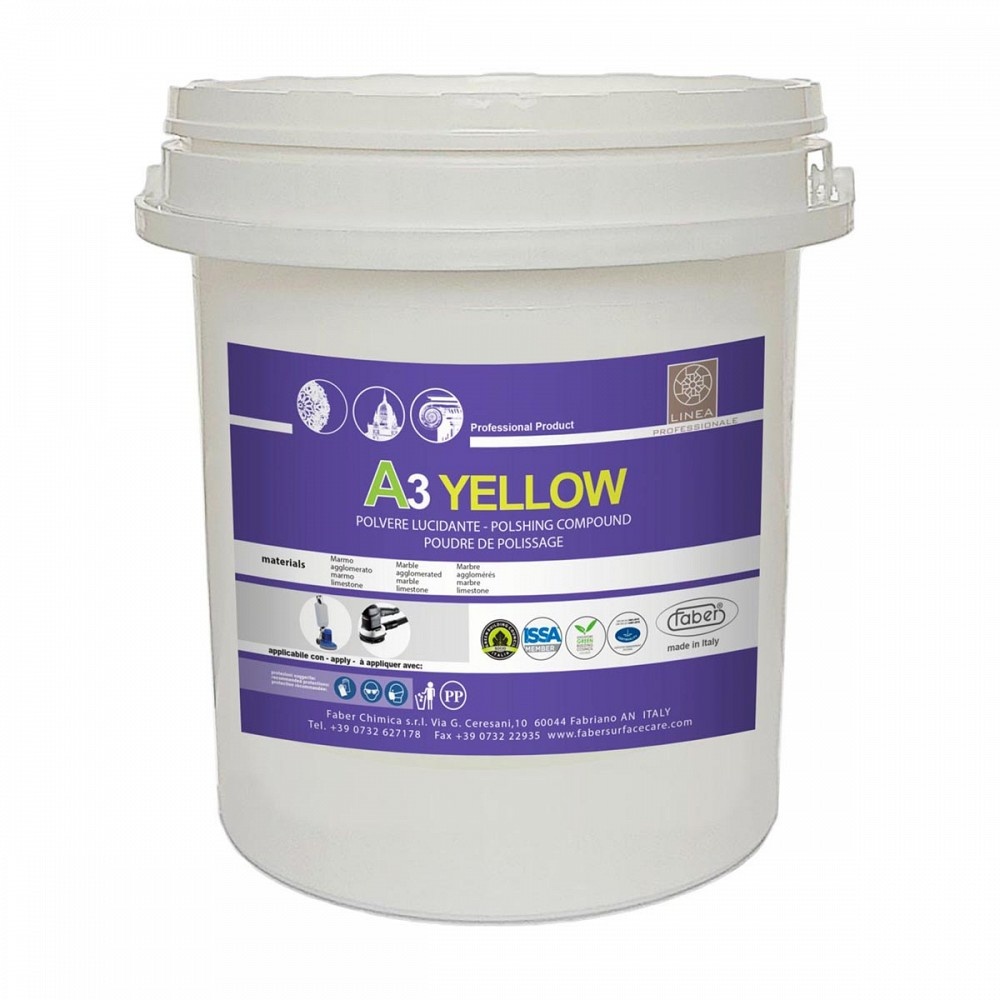
Sure, the natural stone structures are elegant – but there’s a catch. Like other floor installations, they need regular care and maintenance to keep them in optimal condition. This is right from the onset, with the sealing and polishing required, to the regular cleaning to deal with the dirt and grime that is a threat to the structure. Here, we’ll focus on the polishing aspect, where the goals are mainly two: bringing a shiny effect to the floor, and adding to the level of protection. For this, you want to work with a product that has been proven to deliver, and you can find that in the Faber A3 Yellow Marble Polishing Powder.
The functionality of polishing powders is based on very fine abrasive grains. These are applied through buffing, achieving a high gloss. Note that the powders are not soluble in water – so they won’t dissolve during the routine cleaning tasks. The wet method is the most common method of polishing surfaces, since more of the stones respond well to the application when wet. Polishing is an easy and conservative mode of polishing the natural stone surfaces. The powder itself adds to the reflective nature of the finish, and you get a smooth surface. Here, we will focus on what makes the Faber A3 Yellow Marble Polishing Powder an effective product, and how to use it for optimal results.
What You Get From The Faber A3 Yellow Marble Polishing Powder
-
Lustrous effect
With this powder, you get to enhance the aesthetics of the surface being worked on, giving it a superior vitreous finish. This brightness makes the natural patterns and colouration of the treated surface more prominent. The results are further boosted by the depth of shine that is obtained on the floors, walls, counters and other finished surfaces. This is particularly visible when the surface is seen against light. That level of clarity is key in enhancing the ambience of the interior space. The Faber A3 Yellow Marble Polishing Powder achieves this effect without changing the surface hardness of the installation.
Polishing the marble, limestone and other surfaces with this product comes with the added benefit of being easier to clean, since the polished installation doesn’t stain as easily. Sure, you still need to wipe away any spills that occur on it – but the ability to protect that shiny result by warding off stains makes the polishing process beneficial to the property owner.
Are there etch marks on your floor? These negatively affect the look and feel of the premises. They are usually caused by issues such as dragging heavy pieces of furniture on the floor, all through to dirt and grit particles getting grinded against the surface underfoot. Polishing the surface allows you to remove those etch marks, and the Faber A3 Yellow Marble Polishing Powder is the formulation to use to get quality results.
Note that you should ensure that the stains, dirt and other blemishes that are on the surface are first dealt with before the application. Just as the application Faber A3 Yellow Powder makes the marble, limestone and similar installations more shiny, any defects that are on them will also be more pronounced. So giving the installation a thorough wash before application will be key. More on this – and other preparation measures that you will need to put in place – shortly.
-
Wear resistance
Beauty and durability go hand in hand. You want the shine obtained from polishing the surface to last for long, and the installation to retain its structural integrity. From floors to countertops, the durability of the structure is a key consideration, where the goal is to reduce the wear and tear that results from everyday usage. Using the Faber A3 Yellow Powder as part of the polishing process enables you to add to the protection of the floor.
Note that the Faber A3 Yellow Marble Polishing Powder doesn’t contain wax. Instead, the product reacts with the surface itself, providing you with a longer-lasting resistance to the everyday barrage of abuse that is meted out onto the surface – which is especially beneficial for floors given the levels of dirt and foot traffic that they handle.
When polishing floors, another consideration that comes to focus is the slip resistance of the surface. On one hand, you want a shiny floor that enhances the decor, but on the other hand you don’t want people constantly slipping and falling. This is especially in high traffic spaces, as well as environments like kitchens and bathrooms at home, where the higher prevalence of the surface being wet increases the risks of falls. This factors into the development of this powder. The non-slip attributes of the Faber A3 Yellow Marble Polishing Powder come in handy here, making the area safer to walk on.
The minimised level of maintenance of the polished surface – where you won’t have to worry about stripping, recoating or rewaxing the floors, adds to the value of the Faber A3 Yellow Marble Polishing Powder. This higher resistance to oil, tire marks, and other substances that would stain the surface translates to the polished floor preserving its shiny and elegant look for longer.
-
Versatile product
You get a wide scope of reach with the Faber A3 Yellow Marble Polishing Powder. Sure, it has “marble” in its name, but you can also use it and other kinds of lime-based materials, including limestone, travertine as well as agglomerates like marble-cement and marble-resin installations. You can use it to polish the compact carbonate materials which aren’t too sensitive, making it one of the most widely used polishing agents in the FABER “A” series.
Treating surfaces with the Faber A3 Yellow Marble Polishing Powder is a breeze. It has been developed to reduce the workload of the personnel carrying out the task, as well as save on the resources required. For instance, it successfully works as an alternative to the traditional mechanical polishing processes. You won’t need to use the end-stage polishing grains, enabling the surface renovation to be carried out much faster, while simultaneously slashing the amount of water required for the process. Even the waiting time is reduced, since after polishing and rinsing the surface you can allow normal floor traffic to the area. More on the specific application steps shortly.
In addition, this is a zero-volatility wet powder. Basically, this means that you won’t have to worry about dust being released during the process, or particulate matter getting dispersed into the air as you work on the different surfaces. It makes it a safer approach for the personnel carrying out the surface polishing.
One of the reasons why this level of polishing is recommended in countertops and hallways of households all through to hospitals is the repelling of pests and fungi. Are you worried about these growths in your kitchen, or termites infestation attacking your floor? Marble polishing reduces the risks of such issues occurring, and you can get this protection with the Faber A3 Yellow Marble Polishing Powder under review here.
-
Budget-friendly
With the affordable pricing of the Faber A3 Yellow Marble Polishing Powder, you get to make savings right from the moment you make the purchase. The industry-leading position of the brand has allowed it to invest heavily in production lines and deliver floor maintenance formulations at scale, reducing the cost of the individual products. The protective attributes it brings on board reduce the costs that would have gone into making extensive floor repairs and renovations – translating into more savings down the road.
Even with the application itself, you get more bang for your buck with the Faber A3 Yellow Marble Polishing Powder. For instance, with the surface polishing, each kilogram of product gets to cover 40-50m² of surface. For the routine surface maintenance, a kilogram of the powder can cover 50-100m³ of surface, depending on the condition of the area being treated. There are two packaging options, with the Faber A3 Yellow Marble Polishing Powder coming in 5kg bottles, and 20kg tubs. This allows you to get the specific quantity that meets the needs of your establishment. Let’s delve into the particulars of working with the powder.
How To Use The Faber A3 Yellow Marble Polishing Powder
There are two main reasons for using this powder:
-
Restoring the shine to worn-out surfaces where working with a mechanical polisher is not possible; or as a complete alternative to the entire mechanical polishing process
-
Maintaining the shine on surfaces (the routine care to keep that lustrous effect)
The application process itself is straightforward, and can be achieved with a single disc machine that has at least 1.5HP, or you can work with a manual rotary brush.
After gathering your gear, proceed with these steps:
-
Start by preparing the surface. It needs to be clean. Any dust or dirt on the area will interfere with the effectiveness of the treatment. Allow the surface to dry before proceeding – or at least just get to ‘slightly damp’. The Faber A3 Yellow Marble Polishing Powder should never be applied onto wet surfaces. Cover the adjacent surfaces that are not to be treated with the polish.
-
Temperature is a key consideration, where the surfaces being worked on should be at a temperature of between 5 and 40°C. Never use the powder on an overly heated surface.
-
If you’re using the polish on surfaces that have been recently laid or grouted, then first allow the adhesive or grout applied to cure completely.
-
Pour 2 or 3 spoons of the polish onto the target surface.
-
Add water to the product. Generally, for every spoon of the Faber A3 Yellow Marble Polishing Powder, add 2 spoons of water. Basically, the goal here is to end up with a creamy paste, which will then be distributed to the rest of the surface in the next step.
-
Use the single disc machine set at 150-200 rpm to apply the product to the surface. This machine should be fitted with a white pad. Ensure that you have achieved a uniform application, where you can pass over every area a couple of times.
Handy tips:
-
It’s recommended that you work in stages, breaking the surface down into sections of 2m² at a time.
-
You can work with the WARRIOR single disc machine from Faber Chimica. It clocks a 2.2HP, and is optimised for the application of these kinds of formulations.
All through the application, the paste should maintain a creamy consistency. If you find it becoming too dry, simply top up a little water to it. Never allow the paste to dry during the application process
-
Buff the surface until you get the desired maximum shine. To test this, remove a small area of the polish with a squeegee mop then check the level of shine.
-
If the goal is restoring the shine to a worn out surface, if you’re buffing the surface after polishing it, pass over the different sections 20-25 times.
-
If you’re carrying out the regular polishing to maintain the shine, then you’ll just need to make 10-15 passes over each section. Here, less amount of Faber A3 Yellow Marble Polishing Powder will be required – just around 1-2 spoons for every section.
-
After you have obtained the required shine, vacuum away the residue then rinse the area with lots of clean water.
That’s it. No extra waiting time is required. You can open the area to normal foot traffic. The tools used for the application can be washed using water.
-
As is with any other floor treatment product, if you’re uncertain about its compatibility with your particular installation, first carry out a spot test on an inconspicuous area before proceeding to use it on the rest of the surface.
Guide to Finish Effects For Your Natural Stone Surface
When considering the kinds of process to use for your particular floor, this will depend on the desired end-goal. For starters, there are 4 general categories of finishes that you can go for:
-
Polished finish
This is such as for the case of the Faber A3 Yellow Marble Polishing Powder, where you’re after a smooth and shiny look. This is the most popular approach, due to the aesthetic appeal of that glossy effect that is obtained, the protective attributes, as well as the ease of maintenance. When making your choice of product to use, be keen on the slip resistance. Polished surfaces can get slippery when wet, so you ideally want to deal with a product that comes with extra slip resistance properties.
-
Honed finish
This delivers an “old-world” casual vibe. The effect here usually has a velvet feel since the abrasives that are used remove some of the actual stone. With this rougher effect, you won’t have to worry about slippage. However, the resultant surface is more porous compared to the polished surface, meaning that the installation will be more susceptible to staining. The sealing will also need to be done more frequently.
-
Tumbled finishes
These kick things up a notch from the honed finishes when giving the room a distressed look. Here, the surface features will include cracks, scratches and even chips. The stone tiles will have been tumbled in drums that have abrasives to give more texture to the surface. It results in a stronger grip, which is why such tiles are placed in areas like bathrooms.
-
Brushed finish
This also aims for that aged effect. The tiles are brushed to give the surface the desired texture. Note that the stain resistance is weaker here, so more frequent sealing is needed. There’s also a higher tendency for dust and dirt particles to collect more in the crevices that have been formed, so more effort will also go into the routine cleaning processes.
A Trusted Brand
When getting floor treatment agents, you want to be sure that you’re dealing with a brand you can rely on. Sure, all manufacturers claim that their product is the best in the market – but can you take their word for it? Take time to go over the reviews that have been left behind by other customers who have purchased their products. This can be on social media pages, all through to business directory listings. How long has the company been in operation? The floor care industry is highly competitive. Companies that have survived for long in it must be good at what they do, in order to grow a loyal market base. The scope of the operations also has an impact on the eventual cost of the products that are available, since companies that have large production lines and better logistics will be able to deliver the products at more affordable prices to the end consumer.
The brand behind the Faber A3 Yellow Marble Polishing Powder has been in the floor care industry since the 1980s. It was founded in Italy, specialising in the production of formulations used in the care of a wide range of building surfaces, from natural stone installations like granite and marble, to the manmade structures like ceramic, cotto and agglomerates. Over the years, it has extended its business, becoming a major exporter of the products all over Europe, the Middle East, and Asia. From England and France, the UAE, Saudi Arabia and other Gulf nations all through to China, Hong Kong and Singapore, the products from Faber have become widely popular, used by builders and architects, professional cleaning companies, to industrial applications.
Here, you have a brand that has invested heavily in the research and development of products that provide protection during the installation stages of the floors, countertops and other surfaces, routine maintenance, all through the lifetime of the installation. These include stone sealers and impregnating agents that come in to protect new installations from rising damp, water, dirt, rust and stains; stain removers that bring back the original beauty of the surface; as well as mastics and epoxy systems that are handy in repairing natural stone. The detergents developed by the brand are formulated to deliver the required cleaning action without posing a risk to the structural integrity of the installation. Even the polishing agents are diverse, from the A1 Gray that is used on delicate acid-sensitive surfaces, the universal A2 mix with its deep vitreous effect, to the wet Faber A3 Yellow Marble Polishing Powder we’ve been analysing here, and water-based creams like the famed K100 from the brand. This diversity allows you to work with formulations that address your particular needs.
Solutions from Faber Chimica are relied on by both professional contractors and your everyday homeowner. From cleaning, maintenance and repair, working on floors, walls, worktops, stairways – both indoors and outdoors, you’re dealing with a brand that has covered the bases, giving you a wide pool to choose from for products that are effective in their performance, while being gentle on the underlying surface. In fact, there are over 250 different formulations, each unique in their own right. The emphasis on quality has seen the brand obtain the ISO 9001:2015 and ISO 14001:2015 certifications.
Maintaining Surfaces Treated With The Faber A3 Yellow Marble Polishing Powder
Getting that vitreous effect on your surfaces is not the end of caring for them. Sure, the treated floors, countertops, walls and the like will have enhanced durability, but that does not mean they should be left to the mercies of daily life and the elements. Fortunately, the routine maintenance that follows the Faber A3 Yellow Marble Polishing Powder is a walk in the park. The brand has provided formulations that are compatible with the polish, that way you get to deal with the grime and stains without putting the finished surface at risk.
For the routine cleaning, you can use Neugel or AlgaFloor, both from Faber. In case of particularly soiled surfaces or deeper cleaning, the Faber 30 comes in handy. Additionally, over time when that shine slowly fades, the surface can be quickly restored using Cristalfab or Cristalfab White Pad.
As we’ve covered, the polishing action itself increases the resistance of the surface to staining. However, in case you want extra protection from this, it can be obtained by treating the installation with the Hidro 150 or Protex WB. They will not affect the shine that you obtained when you worked on the surface with the Faber A3 Yellow Marble Polishing Powder
Here are extra pointers that you should note:
-
Sweep the floors and dust the countertops regularly to remove the dust and dirt. Using a microfibre duster or similar cleaning tool is recommended since they are gentle on the surface.
-
When mopping, you shouldn’t work with a mop that is completely drenched. A damp mop should get the task done. Frequent mopping gets rid of the dirt and grit that is a major contributor to the wear and tear meted out on floors. When mopping, use warm or cold water. Hot water causes the lime-based installations to streak. Speaking of which, if there are streaks that have been formed on the floor, simply dry the surface with a terry cloth towel or carry out a round of buffing using a residential buffing machine.
When getting into the specifics of this, deionized water is preferred for the mopping process, especially when dealing with structures like marble since it will be safer for the installation. When water with magnesium or potassium salts is used to regularly clean the floors it can cause issues like spalling, pitting or yellowing. Also avoid using ceramic tile cleaners, and generally the conventional floor cleaners on the lime-based installations. This is as they can cause the surface to become dull.
Still on the focus of liquids on your marble and limestone installations, it is recommended that you place house plants on special stands or bases, to prevent water spilling over.
-
Spills like coffee, juice and wine should be cleaned up as soon as they occur. The permeability of the lime-based installations makes them more susceptible to absorbing these liquids, increasing the risks of discolouration. When the surface has been worked on with the Faber A3 Yellow Marble Polishing Powder, chances of this staining occurring are greatly reduced – and as mentioned there are additional treatments from the brand that can add to the protection. However, this does not mean that you should allow the spills to remain on the surface. These treatments buy you time to clear the spills before any permanent damage can occur.
-
Stay away from abrasive cleaners. While the limestone, marble and similar installations appear soft to the physical touch, they can get scratched when abrasive cleaning agents are used. These will erode the top layer of the stone, and the longer one works with them, the more extensive the damage is. This also means that wire or scouring cloth should not be used, to avoid scratching the marble.
Acidic cleaners are another no-no, and this includes popular DIY hacks like lemon juice, vinegar and similar agents. These will react with the natural stone structure, “eating away” at the material. Stick to the cleaners that have been certified to be safe for dealing with such installations, such as Neugel and Algafloor formulations that have been cleared for use on floors that have been treated with the Faber A3 Yellow Marble Polishing Powder. These have been developed to ensure that the structures being worked on are not damaged in the course of the cleaning.
Speaking of acidic liquids, even the likes of wine, carbonated beverages, orange juice, cranberry juice and even apple juice can dull the surfaces, adding emphasis to the need to ensure that they have been dealt with as soon as possible after the spills land on the floor. You should never attempt removing stubborn stains using bleaching agents, scraping or scouring, as these will accelerate the damage to the installa
0 Comments
Questions or feedback? Join the discussion below.
No comments yet. Be the first to comment.
Replying to