
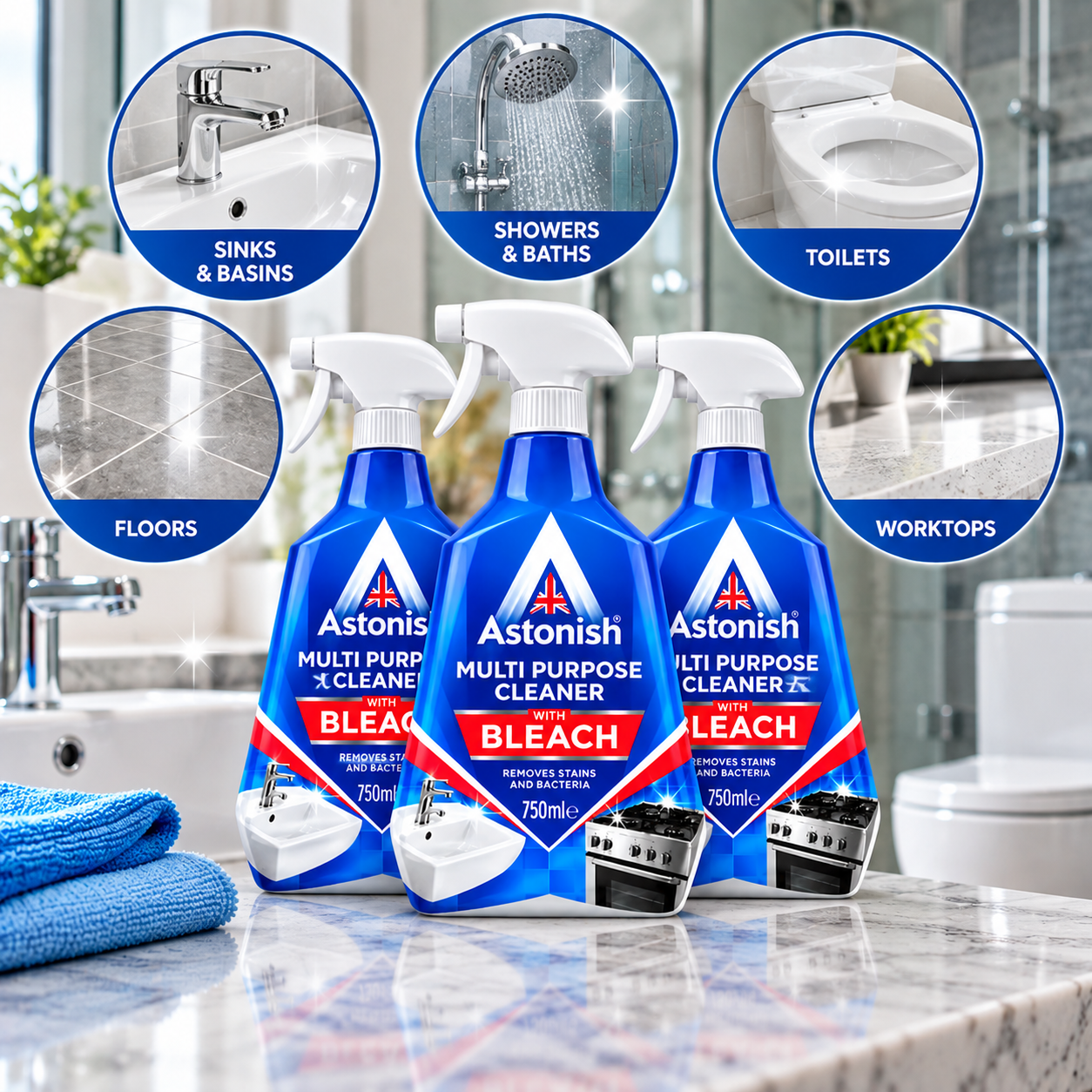
Get More From Your Astonish Multi-Purpose Cleaner With Bleach
Find Outr How Get More From Your Astonish Multi-Purpose Cleaner With Bleach
Some marks you can get rid of with just a damp cloth. Others exasperate you.
We’re talking tea rings that have settled around the sink. All that residue from day-to-day cooking that gets on the splashback, and builds up into mounds of grease. Patches on bathroom surfaces that dull out the place, even when you keep wiping them. Astonish Multi-Purpose Cleaner With Bleach works on those stubborn areas. It’s what you go for when plain water or a mild general cleaner simply don’t get the job done.
Use the Astonish formulation to remove food staining on hard surfaces. Put it to work on that pale sink with evidence of countless mugs of tea. Brighten up damp area-marks in the bathrooms and stop getting cringed out each time you step into the shower. Astonish Multi-Purpose Cleaner With Bleach packs a punch. Let’s look at what it brings on board.
How The Formula Works On Everyday Mess
Surfactants Help Lift Soil
First, the grease problem. It’s frustrating when you’re wiping the splashback and somehow the greasy patch gets bigger. Why does this happen? Oil and water do not mix well. A damp cloth can end up pushing the grime around.
The 750 ml Astonish Multi-Purpose Cleaner trigger spray comes with sodium laureth sulfate and cocamine oxide (anionic and non-ionic surfactants at less than 5%). These surfactants help loosen greasy dirt. You then pick it all up with your cleaning cloth.
No more running your finger over the tile and feeling that thin, sticky layer of grease..
Same thing with bathrooms. Once the oily and soapy portion is loosened, the surface is much easier to wipe clean. Your cloth still has work to do, but the chemical action of Astonish Multi-Purpose Cleaner does the heavy lifting.
Sodium Hypochlorite Provides The Bleach Action
The bleach component is sodium hypochlorite (present at less than 1% in the mixture). Its main job is to help with visible staining from things like tea, coffee and some foods.
Take your white sink after breakfast for instance. Someone pours out the last bit of tea, gives the cup a quick rinse and walks away. Checking it a few hours later, there is a faint brown ring around the plughole.
Sodium hypochlorite acts directly on the coloured parts of that stain. So while the other cleaning ingredients are busy working on the dirt for it to be lifted off, the bleach is ensuring that there won’t be a stain left behind..
Coffee also has that effect. Maybe there is a little splash near the drainer that nobody noticed. By the next morning, it has dried into a brown streak that stands out beautifully against a pale surface. It’s quite a nasty setting, and one that you definitely want resolved quickly. You can get that done with the Astonish Multi-Purpose Cleaner.
Food stains can behave the same way. Like the case of sauce on a suitable pale work surface. Or a little coloured residue left behind after you have already wiped away the actual food. When you wipe off the contents, the colour can still remain. Bleach gets rid of it.The cleaning ingredients help remove the grime. The bleach helps tackle the stain left behind.
This action is why the Astonish Multi-Purpose Cleaner is particularly popular on light coloured surfaces, which are notorious for having those ‘screaming’ stains.
Just remember that bleach cannot fix actual damage. If the surface is faded, cleaning will not bring the original look back. Leaving bleach on for longer will not rebuild a worn finish. Scrubbing harder will not reverse scratches.
Alkalinity And Contact Time.
With a pH of 12.5 to 13.4, the concentrated formula is strongly alkaline. Here, a little control goes a long way. It is also not a cleaner you need to drown the surface in. Work on one manageable patch at a time. Just spray enough to wet the area, then leave it alone for the recommended 1-2 minutes.
You do not need to stand over the sink scrubbing furiously. Let the product sit for a moment and get on with something else nearby. Rinse your cloth. Move a bottle out of the way. Put the mug beside the sink into the dishwasher after promising yourself you would do it three hours ago.
Then come back and wipe.
Keeping the job small and controlled also makes it easier to see exactly where the cleaner has been applied. That is especially useful when several different materials meet in one area, which happens rather often in kitchens and bathrooms.
What The Liquid Is Like
The cleaner is a clear, pale-yellow liquid with a light floral bleach scent. It is also quite runny (handy when you want to cover a spot quickly, but it does also mean you need a bit of control with the trigger).
A couple of well-aimed sprays works nicely. Too much and the liquid starts sliding down the rest of the space before you have even put the bottle down.
So keep the nozzle fairly close to the surface and spray only where you need it. It gives you good coverage without wasting product. No need to have it wandering into the cupboard edge, sealant or fitting below.
Used with a little restraint, the thin consistency is also useful. It spreads easily across the surface, reaches the area you want to treat and is simple to wipe away afterwards.
In other words, you do not need to soak the place to get the job done. A controlled spray gets things done. You get more efficiency and avoid creating another mess while cleaning the first one.
Where You Can Use It Around The Home
What does “Multi-purpose” include? Compatible hard surfaces. You are choosing where to spray based on the material, not simply because something happens to be in a room that needs cleaning.
Kitchen Hard Surfaces
Around the sink, you may find a tea ring, a missed coffee splash or greasy residue around the drainer. Then there is the splashback that’s always a victim of tiny droplets of cooking oil in that busy space. Over time, they build up into a sticky film.
On the compatible hard surfaces, Astonish Multi-Purpose Cleaner With Bleach helps with both the grease and the staining. Pale sinks are especially unforgiving. Yesterday’s cuppa can leave a brown shadow long after the obvious mess has gone. You can resolve this too.
Just keep an eye on what sits around the area you are cleaning. A stainless-steel sink may be beside laminate, painted cabinetry, aluminium trim, timber or stone. That is a lot of different materials within one spray action.
So aim carefully. No need to mist the whole corner like a houseplant.
If you use the cleaner on metal, plastic or rubber, rinse afterwards with clean water. And if you are looking at a surface that you’re not sure of, go back to its installation and maintenance guidance.
Bathroom Hard Surfaces
The bathroom collects its own special mix of mess.
Around the basin, you may have toothpaste splashes, soap residue, cosmetics, body oils and water marks to deal with. And they all build up quickly if neglected. The space ends up looking all tired and forlorn, which is not the setting you want when you’re freshening up. Fix things with this Astonish Multi-Purpose Cleaner.
Use it on the tiles (and remember to keep an eye on those surrounding surfaces). Rubber seals, metal fittings, painted trim and natural stone can all be within a few centimetres of one another.
Have the bottle close to the area you are cleaning and spray with control rather than creating a bleach cloud across the room.
The Astonish solution is also among the products tested and approved by the Vitreous Enamel Association for use on vitreous enamel surfaces (that gives you the go-ahead for enamelled baths and sinks).
Drainers And Tiled Areas
On a compatible surface, spray the marked area and give the cleaner the one to two minutes to work. Then wipe it away with a clean damp cloth.
You do not need to attack the surface with furious scrubbing.
If the surface is metal, follow the wipe-down with a clean-water rinse. It is a small step and also one of the easiest to forget once you have admired your now-cleaner sink and mentally moved on to something else.
Tiles can be treated in much the same way when you are dealing with ordinary grime or staining, provided the material is compatible.
Grout requires a little more care.
You may have standard pale grout in one section and coloured, sealed, ageing or specialist grout in another. They should not automatically be treated as though they are identical.
If you are unsure, check the care instructions for the installation and test a discreet area first where appropriate.
Awkward Corners And Spot Cleaning
Some of the most irritating dirt in the house has an uncanny ability to settle precisely where your cloth does not want to go.
Around the base of a tap. Or along the edge where the sink meets the wall.
Perhaps behind the tap where there is approximately enough room for two fingertips and absolutely no room for patience.
This is where the trigger spray becomes especially handy.
Rather than soaking a whole section just to reach one grubby patch, you can direct a modest amount of cleaner onto the problem area. Keep the nozzle close, target the mark and let the formula work for its one-to-two-minute contact time before wiping it away with a damp cloth.
And try not to fall into the “more must work better” trap. Usually, more spray just means more product running into places you did not want it and more wiping for you afterwards. A controlled spray. A short wait. A damp cloth. That’s all you need.
How To Use It Properly
Using a bleach cleaner properly is not about putting in more elbow grease. In fact, the best results usually come from letting the product do its share of the work.
Check The Surface First
Maybe you are facing a tiled splashback. Easy enough.
But right beside it there could be painted cabinetry, an aluminium trim, a rubber seal, a wooden edge or a bit of natural stone. Homes are very good at squeezing several different materials into one tiny area.
That is why the first step is always to identify what you are actually cleaning.
Do not use Astonish Multi-Purpose Cleaner With Bleach on aluminium, painted or varnished surfaces, fabric, wood or paper.
For natural stone, check that bleach will not affect the colour or finish.
If you are unsure about any surface, check its care instructions first. Where bleach is allowed, test a small hidden area before cleaning the whole surface.
Now clear the immediate area. Move food, towels, toiletries or anything else sitting within spraying distance.
And if you used another cleaner there a few minutes ago, rinse it away thoroughly before you continue. This is not the moment for a little accidental chemical reaction.
Spray And Leave For One To Two Minutes
Spray enough cleaner to wet the area you want to treat, but do not soak it (even if you are working on a tiled wall, shower surround or another vertical area). Too much product will simply start travelling south. And that risks your finish and fittings.
Keep the spray controlled and close to the target. Then leave it alone for around two minutes.
You do not need to spray and wipe it away instantly, but you also do not need to go wandering off for half an hour.
Wipe With A Clean Damp Cloth
This removes the cleaner along with the loosened grime.
As the cloth gets dirty, fold it over and use a fresh section. That way you won’t be transferring grime from one spot to the next.
If you are dealing with a textured area or shallow groove, a suitable non-scratch sponge may help (while still following the surface care instructions). Note the ‘non-scratch’. The last thing you want to do is turn a stubborn mark on your glossy finish into a permanent scratch.
Tough Stains The Astonish Multi-Purpose Cleaner Can Help With
Tea, Coffee And Food Staining
Have a look around your kitchen sink. There is a good chance you will find a tea or coffee mark somewhere, especially if you have a pale sink or drainer.
Perhaps someone poured out the last bit of tea yesterday and forgot to rinse the area. By morning, that innocent-looking splash has dried into a brown ring around the plughole. You wipe away the loose residue, but the colour refuses to budge.
Astonish Multi-Purpose Cleaner With Bleach is useful for this kind of staining on compatible hard surfaces. Its sodium hypochlorite works on certain coloured compounds in tea, coffee and food stains, helping make those marks less visible.
Food spills can leave similar reminders. Like a splash of sauce on a suitable pale worktop that leaves a faint stain even after you have wiped away the actual food.
Just remember to check what you are cleaning. A wooden chopping board, painted table or unsuitable stone worktop is still off-limits, however annoying that stain may be.
Grease And Cooking Residue
There is usually a greasy patch somewhere beside the hob.
Maybe it came from last night’s frying. Maybe it has been building quietly for days. Either way, plain water tends to spread it around more than remove it. Use the spray where cooking residue has settled.
Just do not assume everything around the cooker is fair game.
A suitable surface can sit right beside printed controls, aluminium trim, coated panels or specialist finishes. Kitchens like to keep things complicated.
If there are crumbs, food scraps or obvious debris, clear those first. You want the cleaner working on the greasy film stuck to the surface.
Soap Marks And Bathroom Grime
That dull film creeping over the shower wall (or around the basin) is likely a mix of soap, body oils, dust. Pesky little splashes that dry where they land. The cleaner’s surfactants + bleach combo deals effectively with them.
Note that chalky mineral scale from hard water is chemically different from ordinary soap film and greasy soil. If that is what you are dealing with, go for a dedicated limescale remover, and make sure it is safe for the surface first.
Mould And Mildew
Few things spoil the look of a clean bathroom faster than these dark marks creeping into damp corners. They’ll be near the shower, along a tiled edge, and basically any area that doesn’t dry properly. Counter them with the Astonish Multi-Purpose Cleaner With Bleach.
But what if the patches keep coming back? Then you have a bigger problem at hand. It could anything from condensation collecting after every shower, the extractor not being switched on, to even a small leak you have not noticed.
Persistent damp gives mould and mildew the moisture they need to keep returning. So fix the underlying problem for it to stop recurring.
Surfaces And Materials To Avoid
Bleach is powerful for being chemically active. Risk comes with the territory.
Aluminium
If you cannot tell whether a fitting or trim is aluminium, check before spraying. That stainless-steel sink in your kitchen, shiny appliance fittings and thin metal strip along the edge of the worktop may all look metallic, but that does not mean they are made from the same thing.
Pay close attention around hobs, sinks and appliances. These sections have different metals sitting right next to each other. You don’t want to accidentally catch an aluminium edge with the spray when working on adjacent areas.
Painted And Varnished Surfaces
Be it walls, cabinet fronts, doors, as long as they are painted, don’t use the product on them. Same goes for varnished furniture.
This is also why you should be careful with the layout of a room. A tiled splashback may be suitable while the painted panel touching it is not. Spray towards the target, not across the whole corner.
Fabric, Wood And Paper
You get a stain on your white tea towel. Won’t anything with bleach help you? It doesn’t work that way. Fabric, upholstery or clothing need products designed for their care and washing requirements.
Wood and paper are also unsuitable. That includes wooden chopping boards, timber worktops, wallpaper and other paper-based finishes.
Even if your wooden worktop has a mark that has been bothering you for weeks, this is not the cleaner to experiment with. You could end up affecting the colour or finish instead of improving it.
Natural Stone
Be careful around marble around the bathroom basin, granite in the kitchen or limestone tiles on the floor. Sure, they are all stone, but their surfaces can behave quite differently.
Even two marble worktops may have different sealers or finishes, so what works on one might not suit the other.
Check the care instructions for both the stone and its protective finish. If bleach is permitted, test a small hidden area before treating a visible stain.
And if the manufacturer advises against bleach, don’t go experimenting with your unit. A coffee mark is annoying, but damaging an expensive worktop is considerably worse.
Unknown Or Delicate Finishes
Have no idea what material is made from? Like that unusual glossy panel in the bathroom or the worktop you inherited when you moved in? Here, err on the side of caution.
Specialist composites, decorative coatings and delicate finishes can need particular cleaning products. Find out what the surface is and check its care instructions before using bleach.
Bleach Cleaner Safety At Home
Almost every home has some bleach agent or another at this point. So it’s easy to get all casual around it. However, treat your Astonish Multi-Purpose Cleaner with the same care you would give any active household chemical.
-
Never Mix It With Other Cleaning Products
Say you have already sprayed something on the sink, it has not quite done the job, and you are tempted to reach for another bottle and add that on top. Don’t.
Never spray this Astonish product directly over another cleaning product (including vinegar). Do not pour two cleaners into the same bucket or combine them in one spray bottle either.
Some chemical combinations are dangerous. Sodium hypochlorite is incompatible with acids, hydrogen peroxide, ammonia and ammonium compounds. Mixing chlorine bleach with acids can release chlorine gas, while ammonia-containing products can also cause harmful reactions.
If another cleaning product has already been used, rinse the area thoroughly with clean water and remove the previous cleaner before starting again.
-
Use It With Ventilation
The first step before cleaning the bathroom should be opening the window or switching on the extractor. Let fresh air move through the room. That’s way better than having spray mist and vapour build up around you.
Stakes are higher in small bathrooms, utility rooms or other enclosed spaces where air does not circulate easily.
Keep the bottle fairly close to the surface and point the nozzle away from your face. That way, most of the spray lands exactly where you want it instead of floating around the room.
-
Protect Skin And Eyes
Working on a big cleaning job? Rubber gloves are worth having nearby. They are particularly useful if you have sensitive skin or expect to spend some time handling cloths dampened with the cleaner.
Accidental splashes can happen, even when you are being careful. If the cleaner gets onto your skin, rinse it off with water. If it reaches your eyes, rinse immediately with plenty of running water.
-
Storage And Spills
After the cleaning, put the bottle back somewhere children cannot reach it. Of course, it should remain in its original labelled container to avoid confusion. Anyone who picks it up must be able to see exactly what is inside.So no pouring leftover cleaner into an empty drinks bottle or an unlabelled spray container.
Store it under normal room conditions too.
And what if you accidentally knock the bottle over? Deal with the spill straight away. Absorb the liquid with kitchen roll or another suitable disposable material. Bin that, then wipe the affected surface with a damp cloth.
Check what the cleaner has landed on, too. A small puddle left sitting underneath a cupboard or on a delicate finish may remain there much longer than the recommended contact time.
What Hygienically Clean Does And Does Not Mean
You finish cleaning your kitchen worktop after dinner. Dealt with the crumbs and greasy marks, and the surface looks much better. Would you call it clean? Yes.
But does that automatically mean it has been disinfected? Not necessarily.
People often use words clean, hygienic and disinfected as though they mean exactly the same thing, but there is an important difference.
Astonish Multi-Purpose Cleaner With Bleach is a cleaner and stain remover. It helps remove dirt, grease, residue and visible staining from suitable hard surfaces, leaving them hygienically clean. It is not intended for use as a disinfectant.
And that does not take anything away from its usefulness.
Think about the mess your kitchen handles every day. Cooking grease settles around the hob, drinks leave marks near the sink and food residue collects across the worktop. Removing that build-up makes the room cleaner, more pleasant and easier to maintain.
Disinfection has a different purpose. Here the goal is to reduce or inactivate microorganisms to a defined level. Products used for this have set concentrations and contact times.
Even though Astonish contains bleach, that does not automatically make it a disinfectant.
So when you specifically need to disinfect a surface, choose a product labelled for that job and follow its instructions.
Just remember not to spray the disinfectant directly over Astonish. Finish your cleaning, rinse wherever required and then carry out the disinfection step separately.
Vegan And Cruelty-Free Credentials
Definitely, the effectiveness of a cleaning product is the first thing you look at when deciding what to buy. But in this day and age, additional factors are weighed. One of those is what is behind the product. And whether it aligns with your persoal principles.
The Astonish household range is approved under the Cruelty Free International Leaping Bunny programme. Basically, the company does not use animal ingredients or test its products on animals.
If you are trying to make more thoughtful choices about what comes into your home, those credentials are a welcome bonus. Gets your surfaces clean without you having to worry about some poor animal suffering in the process.
Now, we should point out that vegan and cruelty-free refer to different things.
With vegan we’re talking of the ingredients. Astonish Multi-Purpose Cleaner contains water, sodium laureth sulfate, sodium hypochlorite, cocamine oxide, sodium hydroxide, a modified phosphonic acid potassium salt and fragrance. No animal-derived ingredients.
Cruelty-free, comes down to animal-testing policies. For a product to be truly cruelty-free, a company must ensure that animal testing is eliminated at every single level of its business:
- The Finished Product: The final item was not tested on animals before being packaged.
- The Ingredients: The individual chemicals or natural ingredients used to make the product were not tested on animals by the company or its suppliers.
- Third Parties: The company does not pay outside laboratories or suppliers to conduct animal testing on their behalf.
Just keep things in perspective. Vegan and cruelty-free do not mean mild or suitable for every surface. This is still a bleach-based cleaner, and it still needs the same care around materials, ventilation and application.
Packaging
Eventually, you will reach that familiar moment when you squeeze the trigger and realise there is barely anything left in the bottle. What to do with the bottle?
The good news is that the complete Astonish container, including its lid or trigger head, can be recycled where local recycling services accept it.
Before you drop it into the recycling bin, check your local authority or waste provider’s instructions. Collection rules vary, and not every area accepts the same packaging.
If your local service takes the complete container, you can dispose of it through the appropriate recycling collection rather than automatically sending it to general waste.
Recommended products
Discover more alternatives and similar items.
_5nd-300x300.jpeg)