
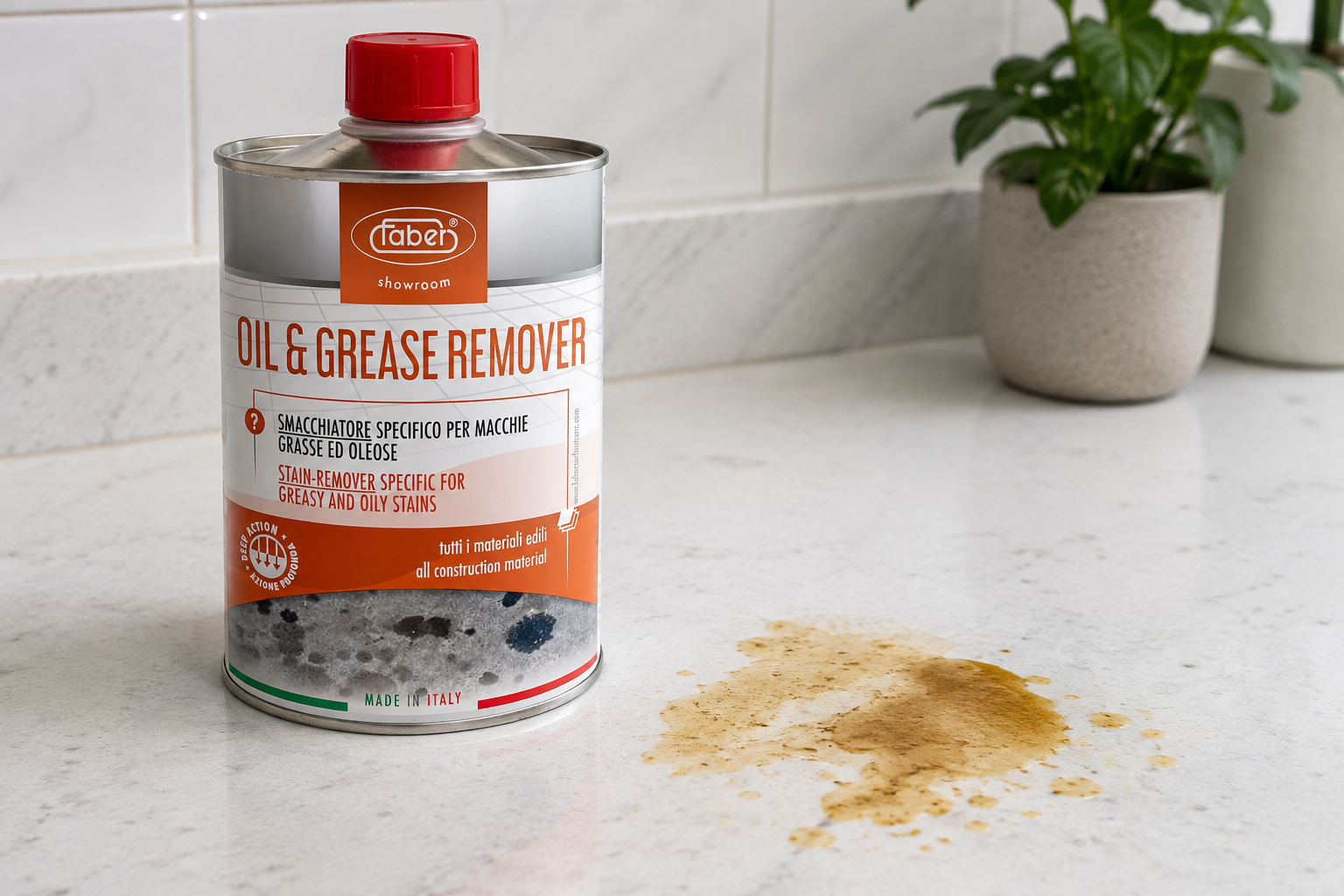
The Faber Oil & Grease Remover
A Look At The Faber Oil & Grease Remover
Troubled by oil on the garage floor? Is there residue on the driveway leading up to your home? What about on kitchen surfaces where cooking oil and other greasy residue have made a mess? These spots are unsightly and need to be got rid of. However, oil and greasy stains are known for being problematic, strongly adhering to the surface. Moreover, some surfaces like natural stone and concrete are porous soaking up the spills and requiring excessive scrubbing. This does not have to be the case for your situation.
Faber has provided the high efficacy Oil & Grease Remover to act on such particular problems, getting rid of the substances without you having to use up loads of time and resources on the task. Faber itself needs no introduction, having been in the surface care industry since the last century, and establishing a solid footprint in the industry. It has achieved ISO 9001:2015 and ISO 14001:2015 certifications for its quality systems. Let’s dive into what the Faber Oil & Grease Remover in particular offers you.
Extracting Deep Stains
Getting rid of those oil and greasy stains is a walk in the park with this formulation. It has been developed to do the heavy lifting for you, removing the stain and residue that are embedded in the surface. Its highly effective against substances like engine oil, cooking oil, diesel and other kinds of fuels, lubricants and mineral oil. Its thick, creamy consistency makes the stain extraction more effective, even working on those old, deep stains. It’s applied directly on the stain and acts on it without requiring any additional help, and it is not mixed with other chemicals. Simply pour it onto the target spot and let it yank out those residues that have been messing up your surfaces.
During stain removal, the chemical formulation of the product used is a key factor to consider, especially with regard to its compatibility with the installations being worked on. You don’t want to be in a situation where corrosive agents have been used, which react with the material and weaken it. This will not be a cause for concern when using this particular product.
While the Faber Oil & Grease Remover is tough on stains, it is gentle on even delicate surfaces like marble and other natural stone installation. In fact, it is suitable for a vast array of materials, from granite, basaltina-lava stone, limestone and quartzite, to agglomerates like marble-cement, marble-resin and quartz-resin, to porcelain stoneware and cement grout.
Since it is also a viscous product, the Faber Oil & Grease Remover can be used on vertical surfaces. To confirm the suitability of the formulation for your particular situation – especially if it hasn’t been stated to be safe for the material, it is advisable to conduct a spot test on a small and hidden area. Here, look at the effect of the product, and whether it preserves the original appearance of the surface.
How To Use The Faber Oil & Grease Remover
Before applying the product, first give the area a round of cleaning. This is to remove the dust and loose debris. Cleaning this rough particulate matter allows the action of the Faber Oil & Grease Remover to be focused on these stubborn spots that are on the surface. After the cleaning, allow the surface to dry. This formulation should not be applied onto wet surfaces. At most, they should only be slightly damp.
-
The temperature of the are being worked on is key as well. Here, the surface should not be overly heated, and should instead be in the range of 5 to 40°C. It’s best to plan for the application to be on the cooler periods of the day. In fact, the surface should not be under direct sunlight when treating the stain. Also avoid making the application when it is just about to rain or frost, or when there is mist.
Once ready, take the following steps to treat the surface with the Faber Oil & Grease Remover:
1. Shake the product in its container.
2. Apply it onto the target area. Ensure that you have covered the section with a thick layer of product. You can use a spatula or brush to control how you spread it onto the area, or simply pour it directly onto the spot – whichever approach you find more convenient for your situation.
The Faber Oil & Grease Remover has been formulated to be used undiluted.
3. Give the treatment time to act on the stain, waiting until it dries to form a white powdery residue. This takes a short time – typically 1-2 hours.
4. Sweep/brush/wipe away the residue. The clean-up tools used here will depend on the particular type of material being worked on. e.g., if you’re dealing with a porous material, then a broom or brush will do, but one with soft bristles. For the compact and non-absorbent surfaces, then you can base an absorbent paper, cloth or towel.
5. After clearing away the residue, use a slightly damp mop or cloth to wipe the area, allow it to dry, and then assess the results.
Should the stain not have been fully removed, the process can be repeated.
-
If you’re dealing with an installation that has a wax treatment on it, this layer needs to be removed. You can use the Faber Solvent Stripper or Wax Remover for the task.
-
The formulation should not be mixed with other chemicals.
-
Adhesives with newly installed tiles or freshly applied grout should first be allowed to cure before using the Faber Oil & Grease Remover on the area.
-
In addition to having a stain remover around, it is also recommended that you take active steps to prevent stains from forming on the surfaces in the first place. Here, the installation is treated with stainproof primers – like the Faber Aqua Treatment, or the Marble & Granite Protector. The choice of product here will depend on the compatibility with the particular surface in question. This will go a long way in preventing spills from bonding with the surface and formulating unsightly stains.
Recommended products
Discover more alternatives and similar items.
-300x300.jpeg)
_2nd-300x300.jpeg)
-300x300.jpeg)

0 Comments
Questions or feedback? Join the discussion below.
No comments yet. Be the first to comment.
Replying to