
Travertine Floor Polishing Systems
Travertine Floor Polishing Systems And Products
Travertine floors are highly popular now. Travertine floors used to be reserved for rich people due to the cost but as the economy has improved in Ireland, most people can afford to install these floors. The travertine floors are durable, look beautiful, are easy to maintain, can be restored many times over and will work with any interior design. There are many types of travertine floors in many colours, many shapes and many levels of porosity. You can find travertine floors in bathrooms, kitchens, halls, sunrooms, spas, etc.
Some travertine floors are used to protect floors while others are used to protect walls. But one thing is for sure, to maintain the stone in a great shape and to make sure that it will last for as long as possible, the surface will require either polishing or sealing.
Types Of Travertine
Travertine flooring is available in Ireland in a wide range of natural colours, with each type offering different levels of porosity, veining and surface character. Ivory Travertine is one of the lightest options, ranging from cream to pale beige. It is generally moderately porous and requires sealing.
Classic Beige Travertine has warm beige, cream and light brown tones. Its porosity ranges from medium to high, particularly when supplied with an unfilled finish. Silver Travertine combines silver, grey, beige and sometimes darker charcoal markings. It usually has medium porosity and distinctive natural holes.
Walnut Travertine features warm brown, caramel and earthy tones. It can be moderately to highly porous. Noce Travertine is darker, with rich brown, coffee and chocolate colouring. Natural cavities can be quite noticeable, giving it medium to high porosity.
Yellow Travertine contains golden, honey and yellow tones and is normally moderately porous. Red Travertine ranges from rusty red to terracotta and can have medium to high porosity.
Travertine can also be supplied as filled and honed, polished, brushed, tumbled or unfilled stone. Filled travertine has its natural holes filled during manufacturing, making the finished floor smoother and less absorbent. Unfilled and tumbled travertine retain more open pores and cavities and therefore require particularly careful sealing and maintenance.
Protecting
The travertine floor is just like a marble floor. They are from the same family but are not the same type of floors. Unlike the marble floors, the travertine floors have different levels of porosity. With all that porosity, the dirt can easily penetrate and transform the look of the stone while different types of coloured liquids can easily stain the surface. There are many ways of sealing, polishing, impregnating and waterproofing travertine stones but there are a few very popular and cost effective ways of doing it.
Impregnators | An impregnator is a type of sealer that penetrates the stone in full and it seals the inside of the stone without glazing the surface. The natural stone impregnator has a special thin composition that enables it to find the travertine pores and block it. By doing so, the dirt cannot penetrate anymore. Anything that is spilled on the surface will stay on the top instead of sinking inside the stone.
There are a number of top quality impregnators from Faber that are super easy to apply and maintain the natural look of the stone. These travertine impregnators are also divided into a few distinct categories. Firstly, there are two types of impregnators, solvent based impregnators and water based impregnators. Just like the name says, one type is solvent based and the other type is water based.
Then, all those solvent based impregnators and water based impregnators, are also divided in a number of categories. Natural looking impregnators that dries 100% natural. Colour enhancing impregnators that darken up the stone. Wet look impregnators, a type of sealer that maintains a wet look finish.
***To be able to apply an impregnator to a travertine floor or wall, the stone has to be 100% unsealed. Any type of barrier will prevent the product from reaching the stone and it will be unable to dry or do what it is supposed to do. Pre-testing for compatibility is highly recommended before doing a large area***
Sealing | A sealant is slightly different from an impregnator. A sealers job is to prevent the dirt absorption by blocking the pores of the stone and building a protective layer over the surface of the stone. The sealer can be water based or solvent based. They can also be available in any possible levels of sheen, some are colour enhancers, some are wet look, some are natural looking.
The sealers are a great option for those travertine floors that are exposed to increased traffic. By applying a few coats of a protector, all the daily traffic is absorbed by the sealer while the floor is left untouched. The benefits of the stone protectors is that it can be applied over pre-existing finishes or it can be used to repair worn and damaged finishes.
Polishing
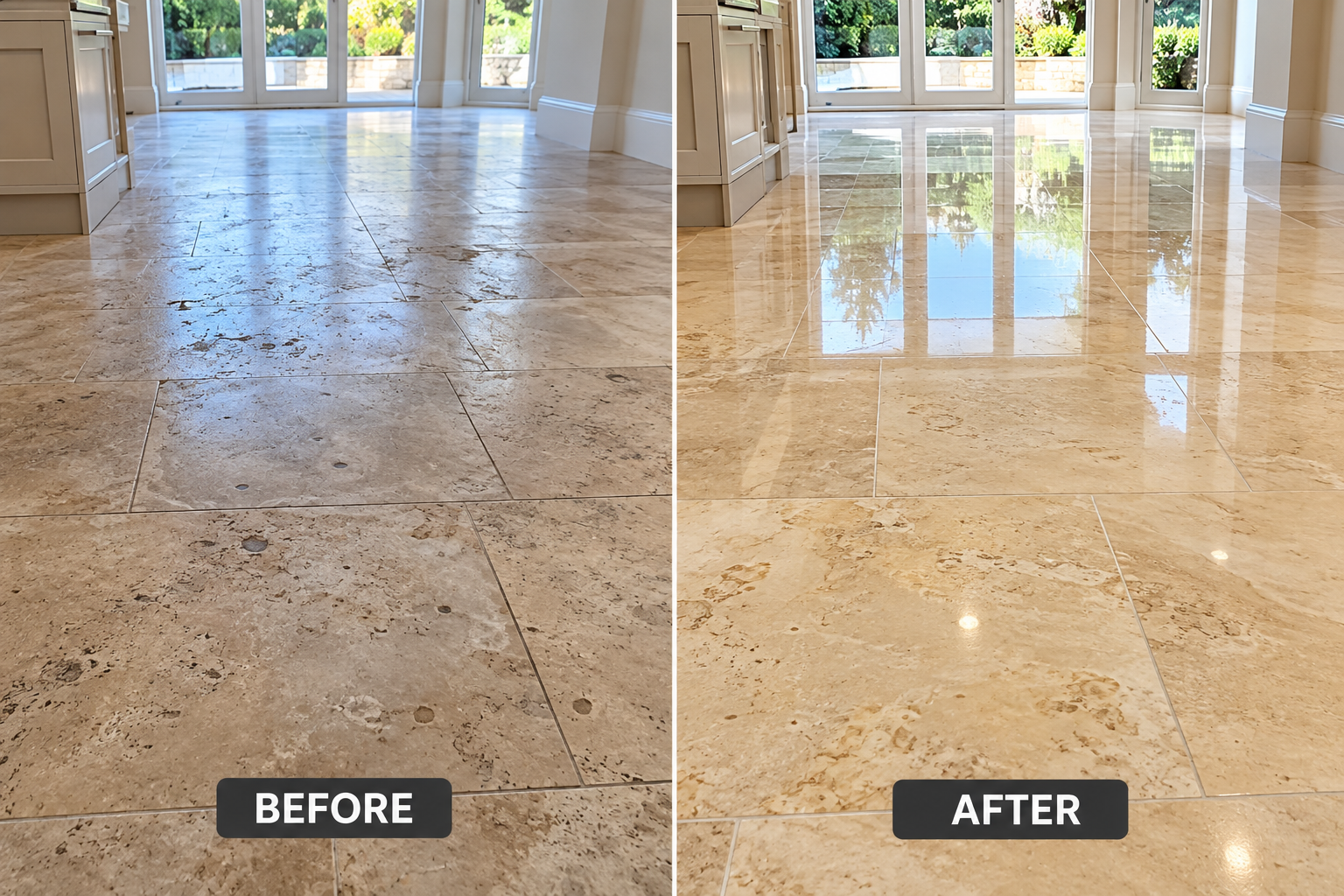
The best way of protecting and reducing the liquid absorption is by polishing the surface. Within the process of polishing it, the surface pores are reduced to a minimum while the sheen levels are increased dramatically. The polishing can happen through a mechanical grinding system where a number of diamond polishing pads will be used to grind the stone and rescue the absorption. Basically, the process of polishing is fine sanding with diamond impregnated pads instead of sanding pads.
Heavy Grinding | The top layer of the travertine floor will be grinded with aggressive diamond pads. All imperfections, dull patches and scratches will be removed during this process. The surface will be left matt and dull.
Medium Grinding | Within this process, less aggressive diamond polishing pads will be used to remove the imperfections created by the first grinding operation and create a soft sheen or satin finish.
Fine Grinding | Within this process, the surface will be grinded with some of the finest diamond polishing pads that will reduce the absorption to negligible levels and it will create a high gloss or highly polished finish.
After the final step of polishing, the job is basically completed but there is one more essential job to be done. The surface will be washed with a stone soap to add an additional layer of protection. The soap will stain-proof the surface and it will protect the surface against spills and dirt penetration.
Other Polishing Systems
The system listed above is the most popular travertine polishing system but there are other polishing systems commonly used by the natural stone polishing industry:
Powders | After the surface is grinded with a medium aggressive diamond pad, some people prefer to use marble polishing powders instead of moving to the fine polishing with diamond pads. There are different types of polishing powders from a number of different manufacturers that can be used to polish travertine floors to give a mirror like finish. The most popular types of marble polishing powders in Ireland are Faber A3 Yellow and Faber A1 Grey. These marble polishing powders are easy to use, require less cleaning and provide incredible sheen in no time. Loved by the professional marble polishing trade.
Creams | Another very popular way of polishing travertine floors is with a polishing cream. Faber K100, Faber Alpha Gloss and Faber Universal Glossy are some of the most widely used and highly recommended products. No specific training is required and very basic tools are required. Most of the polishing creams and liquids are usually used to protect and increase the sheen of already polished surfaces. The creams and the liquids have a great coverage area and provide instant results.
Maintenance
Achieving a great sheen on a travertine floor is just the first step. Maintaining that particular sheen for a long period of time is tricky. The highly polished surface will only stay like that for as long as it is maintained with proper products and buffed as often as possible. The travertine floors are a natural type of stone floor that is affected by the elements.
With daily usage and traffic the pores of the stone will open up and the surface will start absorbing dirt. To prevent that, we recommend all our customers to use Faber Neugel as the main daily cleaning product that can clean quickly and polish the surface. Use a flat mopping system to avoid oversoaking the surface and hire your local floor cleaning specialist to buff your floors at least once per year.
Q & A
Q | Can I wash my travertine floors with acid based or bleach based floor cleaners?
A | No way ! Those highly active cleaning products will dull up the finish
Q | Can I restore my own travertine floors?
A | Maybe. The full restoration process requires tools, knowledge and a lot of hard work
Q | Is travertine floor polishing expensive?
A | Yes. The final price will reflect the condition of the floor, the size and the finish required
Q | How often should I restore my travertine floors?
A | As the floor gets worn out or as the signs of damage become very visible. Most people would have their travertine floors restored once every 3 years
Q | Should I wash my travertine floors with a normal mop or a flat mop?
A | Flat mop all the way
Tips And Advice
The main factor for patchy and dirty looking travertine floors is usually the improper maintenance. Using cleaning products that leave a residue or create a sticky finish is always a bad idea. Many highly polished or sealed travertine floors end up covered with a layer of cleaning product residue because the owner of the floor has used non suitable cleaning products. A travertine floor cleaner has to be PH neutral, non residue and non alkaline.
Many people end up with a patchy finish after applying floor polishes to a travertine surface. The travertine floors are very compact and have a lower absorption rate than other types of natural stones like limestone or sandstone. While polishing travertine floors with water based floor polishes is possible, not all water based floor polishes are compatible with this type of surface. To be able to properly seal a travertine, please check out Faber Hidrofab Polish. This unique formula floor polish is capable of penetrating and attaching to the stone. One coat system only.
If you are looking to maintain a highly polished travertine surface, then maybe you should hire or buy a 17 inch floor burnisher and use it in conjunction with Diafil Diamond Polishing Pad 4. The friction between the pad and the floor will generate incredible sheen and it will restore all dull surfaces.
Use a neutral PH floor cleaner like Faber Neugel. This highly concentrated floor cleaning gel will safely remove all kinds of superficial dirt without leaving any residue behind it. This incredible natural stone floor cleaner is highly concentrated and very long lasting.
Do not ignore the signs of wear. The areas with increased traffic are likely to wear off much faster than the areas with little or no traffic. If you notice discolorations or high dirt absorption, you should move fast and repair it before it becomes too bad. The ignored area will end up having to be grinded and re-polished from scratch.
Expect to have to re-polish your travertine floors at least once every third year but it is based on proper care and maintenance. Your travertine floors are likely to open their pores after it receives a lot of daily traffic. To prevent it from opening its pores, the stone will have to be polished or buffed regularly.
Use a flat mop or a spray mop while cleaning your floors. The excess water contains minerals and salts that will dry and create a patchy finish. The flat mopping system will only release enough water to quickly wash the tile and it will remove the excess water.
Do not put mats and rugs on the newly polished travertine floor. The areas around the mats will wear off much sooner than the area under the mat and you will end up with a big patch right in the middle of your room.
Do not use flower pots on metal trays. All leaks from the plants will cause rust and it will stain the surface for good. Keep an eye on the water while watering the plants and avoid overwetting the plants.
If you need any additional information about travertine floor cleaning, travertine floor polishing and travertine floor restoration, just give us a call. Our team of highly specialised floor cleaning and floor restoration specialists will be happy to help you out and point you in the right direction. We have helped out thousands of customers just like you.