
Fast Protection With Bona Mega Evo Floor Lacquer
Incredible Fast Protection With Bona Mega Evo Floor Lacquer For High Traffic Floors
While wood floors are strong installations, they need extra help to retain their durability. Otherwise, the effects of everyday usage – from foot traffic, scratches by pets, food and drink spills to even cases like vomit and urine incidents will end up ruining the installation. Floor finishes come in to provide a barrier of protection, preserving the structural integrity of the underlying floor, allowing it to retain its appeal for longer.
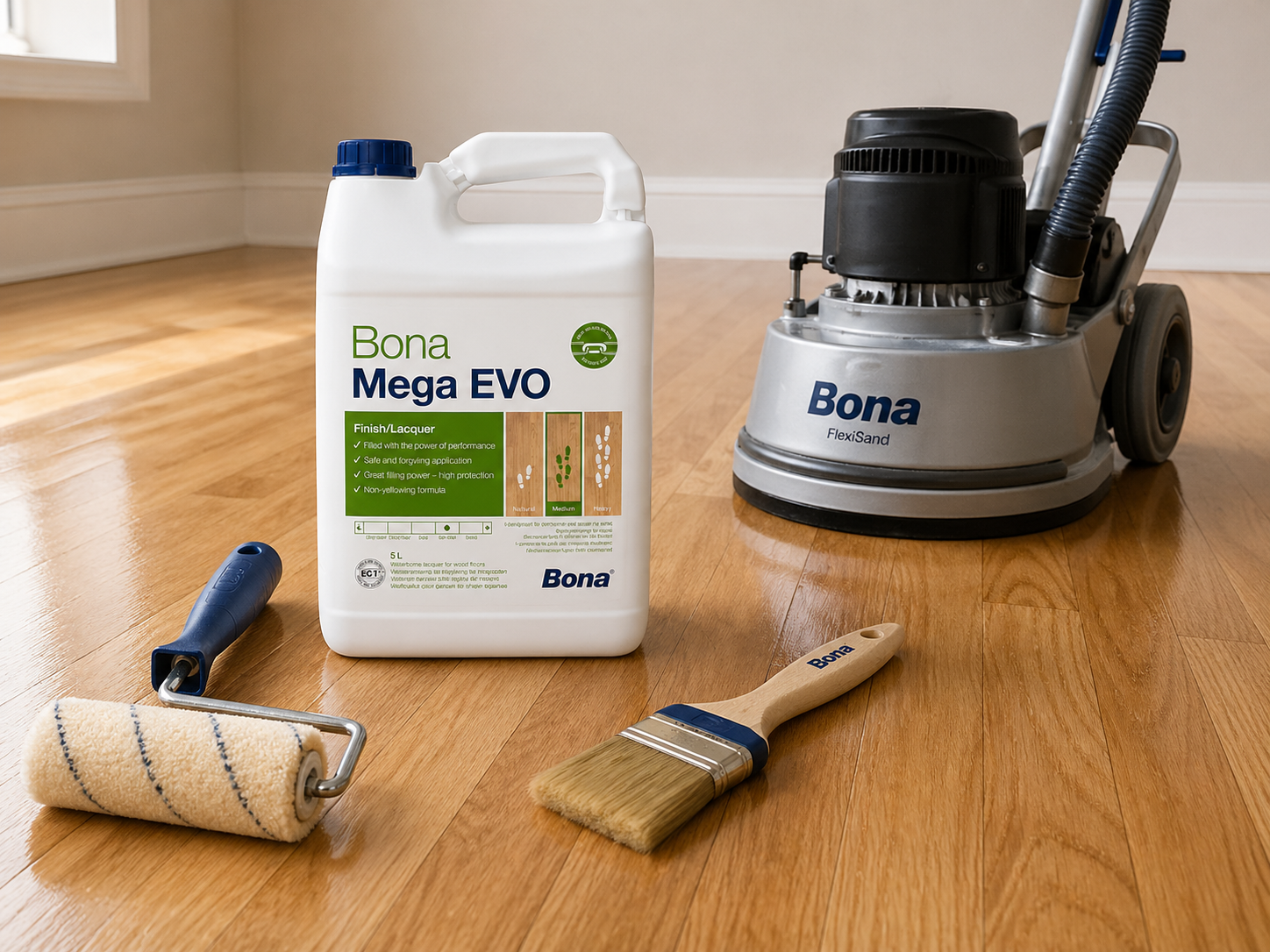
They also come with attributes of their own to enhance the appeal of the floor. Bona has been a world leader in floor care for decades, delivering products that are used by commercial and residential establishments. The different ranges of products come with their optimised properties to address unique consumer needs. Here, we will look at the Bona Mega Evo Floor Lacquer, a water based formulation developed to make the floor treatment process a breeze, while still providing the desired protection.
Benefits Of The Bona Mega Evo Floor Lacquer
-
1-component protection
The priority of lacquers is enabling the treated floors to withstand the wear and tear that they are exposed to. Here, you want to work with a lacquer that matches the level of traffic witnessed in the premises. The Bona Mega Evo Floor Lacquer has been specifically developed for use on busy domestic environments, as well as light commercial areas. The 1-component polyurethane formulation sets a tough protective cat on the floor, preserving the structural integrity of the underlying wood and enabling it to withstand the barrage of abuse that it receives on a daily basis.
-
Warm effect
Aesthetics rank right up there with protection. After all, you want your wood floor to last for long – and look good all through. The Bona Mega Evo Floor Lacquer has been formulated with this in mind, bringing out that warm wood colouration and enhancing the ambience of the premises. This is particularly pronounced on light wood – which is why it’s no surprise that Bona Mega Evo Floor Lacquer is one of the most popular treatments for these kinds of installations.
Moreover, the formulation does not yellow over time – which is a common concern for conventional lacquers in the market due to the effects of solar radiation on them. This allows the resultant effect of the Bona Mega Evo Floor Lacquer to remain prominent for longer, preserving the decor of the premises.
You also get choices for the desired sheen. Here, the Bona Mega Evo Floor Lacquer is available in:
Silkmatt 40% (sheen at 60°), Matt that’s at 20%, Extra Matt coming in at 9%. That way you can work with the specific aesthetic result that you desire for your particular establishment.
There are also formulations you can use together with the Bona Mega Evo Floor Lacquer to tweak the final result as well. These are the likes of Bona White and Bona Decor Paint. Taking these routes will depend on your particular situation.
-
Easy application
Using the Bona Mega Evo Floor Lacquer is a breeze, and it has specific features that contribute to this. For starters, it is a primer and top coat rolled into one. As such, you won’t have to mix it with additional primers before you start the task – which translates into reducing the amount of time taken for the floor treatment. You can simply go ahead and pour it directly onto the floor. The formulation is still compatible with a range of other products depending on the desired final effect – more on that shortly.
Secondly, it comes with enhanced flow and levelling properties, making it easier for the personnel carrying out the task to achieve uniform coats for quality results. The build characteristics are particularly handy in ensuring that you get a strong coat of protection for optimal durability. We’ll delve into the particulars of the application process below.
-
Slash application and drying time
One of the reasons why floor care contractors are fans of this formulation is the reduction in application time, allowing them to cover large areas more efficiently. First, the spreading out of the coats on the floor goes smoothly, and the treatment dries in as little as 1-2 hours, after which the surface can be abraded for the next coats to be applied.
Downtime in the facility is reduced, since floors treated with this waterborne lacquer will be ready to handle light traffic after 24 hours. Note that this time is during conditions of 20°C for the temperature, and 60% relative humidity. The actual time will depend on the prevailing atmospheric conditions in your premises during the application. Be that as it may, the Bona Mega Evo Floor Lacquer still features some of the shortest drying times when it comes to floor treatment products, allowing normalcy to resume in residential and commercial establishments much sooner.
-
Easy on your budget
Building maintenance costs can quickly rack up if proper care is not taken. Bona Mega Evo Floor Lacquer comes in to ease the strain on your floor renovation coats, achieving this in various ways. For starters, you’re getting a product that has been affordably priced. Economies of scale that come with being a world-dominating brand have enabled Bona to invest heavily in production processes and release massive lines of formulations, allowing the costs of individual units to be reduced.
That way, you can get competitive price tags that will allow you to meet your building maintenance needs without digging a hole in your wallet. The packaging sizes also enable you to work with the options that meet your particular needs, where the Bona Mega Evo Floor Lacquer is available in 1L bottles and 5L containers.
Each box of the 1L size units contains 10 of them, while for the 5L containers there are 3 per box. You can also go ahead and acquire entire pallets, especially for the cases where you’re dealing with expansive floor areas. During the treatment process, the abradability properties of the lacquer also come in handy, since it prevents clogging, giving you more usage of the sanding gear that you’re working with.
The cost savings of the Bona Mega Evo Floor Lacquer are also seen in its application rate. Here, each litre of product can cover 8-10m² of floor surface, depending on the particular state of the floor, and the thickness of coats required. With each individual unit of the lacquer covering an expansive floor area, it contributes to lowering the costs of the entire floor care process. Add this to the savings that are a result of the durability of the Bona Mega Evo Floor Lacquer.
Here, surfaces treated with the lacquer have a stronger resistance to everyday wear effects, increasing the duration in between consecutive sanding and renovation jobs. Money saved from the expensive repair and replacement jobs that could have been carried out can be diverted to other tasks in the establishment.
How To Use The Bona Mega Evo Floor Lacquer
First, the floor needs to be prepared. The end goal here is to ensure that the wood surface is well sanded, as the bare surface will enable optimal bonding between the floor and the coats of lacquer that are to be applied. This means that existing treatments need to be removed. Previous polish coats and lacquers that had been applied will interfere with the bonding process. Wax, oil and other contaminants are got rid of, and the surface smoothened out. Note that you don’t have to make the floor ultra-smooth here, as this will also interfere with the workability of the Bona Mega Evo Floor Lacquer treatment.
The recommended gear for the sanding are Bona FlexiSand or Bona Belt.
Some pointers to note include:
– The floor should have acclimated to the environment. This is especially with the new installations, where the floorboards should have been allowed sufficient time to get into equilibrium with the prevailing temperature and humidity conditions.
– The optimal conditions for the application of the Bona Mega Evo Floor Lacquer are 18-25°C for the temperature, and 30-60% relative air humidity. When temperatures are high and humidity levels low, this shortens the drying time. Conversely, when temperatures are low and the humidity levels high, it increases the drying time. The absolute minimum temperature at which the product can be applied is 13°C.
Next, decide on the mode of approach that you will take for your installation. There are two main ways of treating your floor with the Bona Mega Evo Floor Lacquer:
- Using the lacquer by itself, in which case 3 coats will need to be applied onto the floor.
- Starting with one coat of the Bona Waterborne Primer followed by two coats of the Bona Mega Evo Floor Lacquer.
Allow the lacquer to get to room temperature before application, insert the accompanying filter, and thoroughly shake the container. This evens out the particular matter within the formulation. Once everything is in line, proceed with the following steps:
- Use a Bona Roller to spread the lacquer out onto the surface. This should be done in a smooth flowing motion. Ensure that you have achieved a uniform coat.
Tips:
- Alternate between going across and following the wood grain. This is handy in preventing cases of the lacquer accumulating unevenly in some sections.
- As you work with the roller, maintaining a “‘wet edge” will enable you to avoid overlaps.
- Allow 1-2 hours for the first coat to dry.
- Lightly sand the surface, then apply the next layer of lacquer. You can use Bona FlexiSand for this mid-abrasion. Remember to remove the sanding dust, since this will contaminate additional layers that are to be applied. For this, you can use a Bona dusting pad or work with the Bona DCS25.
- The drying time will be progressively longer for each lacquer layer that will be applied. However, note that it is recommended that you stick to a maximum of 2 full coats per day. Going beyond this increases the chances of excessive wood swelling.
- If 24 hours elapse in between consecutive coats, then the surface should always be lightly sanded.
- Before the final coat of Bona Mega Evo Floor Lacquer is applied, use Grit 120 Bona Diamond Abrasives to prep the surface.
- Allow the treatment to dry and cure. You can open the area to light foot traffic after around 8 hours. However, note that you should wait for a minimum of 5 days before you restore carpets and other kinds of floor coverings over the treated surface, or before putting heavy objects on it. Also, during these 5-day drying and curing period, damp mopping should be avoided.
Are there risks of side bonding for your wood floor? This is such as for the case of end grain floors and softwood installations. Hardwood floors where there is underfloor heating can also fall in this category. Here, you should use a primer before treating the floor with the Bona Mega Evo Floor Lacquer.
Air Quality Factor: GREENGUARD Certified
The safety of the indoor air quality is a key consideration when looking at the floor treatment products to use. After all, you don’t want a case where the persons on the premises are exposed to toxic agents that end up putting their health at risk. With the Bona Mega Evo Floor Lacquer, you won’t have to worry about that. This is a GREENGUARD Certified product, having passed stringent tests required to achieve the standard. The GREENGUARD mark that is on the product packaging is proof of this.
To achieve this certification, products undergo different tests to assess their chemical emissions. For instance, VOCs are some of the primary concerns for house maintenance products. These are carbon-based chemicals that evaporate and permeate across the various rooms. They are given off by different products, from floor treatments mattresses, all through to wall paint. Even that ‘car smell’ that is distinct in new cars is due to VOCs.
There could be hundreds of VOCs in the building at any given time. Moreover, indoor air spaces are multiple times more polluted compared to outdoor air, given the confined state. Increased emphasis is being made on testing products that are used in the house to minimise the effect of the VOCs, and GREENGUARD is one of the most accepted standards.
The GREENGUARD testing chambers are polished steel compartments of varying sizes, where the products are placed, and the humidity and temperature strictly controlled. In these dynamic environmental chambers, there won’t be background VOCs contaminating the process, that way chemicals that are being emitted can be accurately measured. Various objects go into the chambers, from laptops, insulating material, and even furniture. The chambers range in sizes, some being as small as ovens, and others being as large as an entire room.
In these chambers, over 200 chemicals can be observed being emitted. The duration in which products remain here varies. For instance, with furniture, it can take two weeks since most of the chemicals will be off-gassed on the first day, and the levels go decaying over time before getting to a steady emissions rate.
With electronics, they can be placed in the chamber for just a day. This is because their highest emissions rate comes before they are plugged in, after which the heat that is generated causes emissions to increase. The certification process lasts for between 1 and 6 months, with the specific duration depending on the particular product being tested.
After achieving the certification, the new versions of the product will undergo annual testing to ensure that they maintain this standard. As such, by obtaining the GREENGUARD certification, you can rest assured that the Bona Mega Evo Floor Lacquer is safe for the indoor air quality. Over 10,000 products have been taken through these strict testing processes, and you can find them on the Sustainable Product Guide.
Picking The Right Floor Treatment Agent
How do you know the right finish for your particular type of floor? There are various issues that need to be considered. These include:
-
Type of finish
This looks at the kind of formulation itself. It affects the overall look of the wood including the colour, which will definitely impact the rest of the ambience. It also has a great impact on the durability of the floor, as well as affecting aspects of the application such as the drying time involved. For instance, oil-based polyurethanes usually bring a rich amber tone to the installation, and are highly durable. However, they tend to have high levels of VOCs – a factor that led to the huge push behind the adoption of the alternative water-based finishes.
There is also that strong solvent smell that is emitted by the product, which can hang in the air for quite a while. The oil-based finishes also tend to change colour over time due to the effect of the sun on them, where some darken, and others develop a yellow tint. On the other hand, water based lacquers deliver the desired floor protection while simultaneously having the lowest VOC emissions amongst the floor finishes. There are no solvents being released into the airspace as the lacquer coats dry, making them a safe finish for those in the premises – such as for the Bona Mega Evo Floor Lacquer under review here.
With regards to the level of protection, you can go for 1-component or 2-component formulations. The former is used for domestic and light-traffic commercial establishments, while the latter can be used in high traffic environments, including airports and public spaces. The built-in UV inhibitors in the finishes means that here the floor won’t end up changing colour – allowing the result that has been obtained from the treatment process to last for longer. There are also moisture-cured urethane finishes.
This is a solvent-based finish that is one of the most durable and it reacts with the moisture that is in the air for it to cure – hence the name. The high durability of these products makes them more ideal for busy commercial establishments. However, they have one core problem: VOC emissions. The moisture cure urethane finishes have very high emissions of fumes, a factor that has caused them to acutely be banned in many areas.
The mentioned finishes – oil-based polyurethanes, water-based lacquers, and moisture cured formulations – are surface finishes. This means that they are applied by forming a layer on the floor, which protects the underlying wood. There are also penetrating finishes in the market. These are developed to penetrate into the wood floor and harden, forming the protective seal. In this case, walking on a floor treated with such products you’re coming into direct contact with the wood, while for the surface finishes there is a barrier of protection separating the soles of the feet and shoes with the actual wood.
These finishes usually include linseed oil and other kinds of oils. They definitely take a much longer time to dry. The main advantage of these kinds of finishes is the aesthetics – getting to give the wood a deeper character, and they also allow for more flexibility during the seasonal expansion and contraction of the wood due to environmental changes in temperature and humidity. However, penetrating finishes have much less resistance to staining, and wear and tear. They can easily be stained by water, solvent, alcohol and other troublesome substances like urine stains. Scratches are also a common problem here, calling for frequent cases of sanding and recoating.
-
Durability
What kind of protection do you desire for your floor? How many kids and pets are there in the household? Are there high or low numbers of customers and employees in your workplace? Will the occupants of the premises be walking around with dirty and wet shoes often? These all come into focus when looking at the strength attributes desired for the floor finish that will be applied.
The three main categories that affect the durability of the preferred finish are its abrasion resistance, scratch resistance, and chemical resistance. For the abrasion, you’re looking at how well the finish will withstand the everyday wear from the foot traffic, dirt and other issues that rub against the surface of the floor, causing it to gradually wear down. The level of protection required for a domestic environment is different to that for an office space or shopping mall complex. Here, the main issue to look at is the level of traffic handled by the premises, and getting a floor finish that is compatible with it.
For instance, with the 1-component Bona Mega Evo Floor Lacquer, it has been particularly optimized for busy homes – even those with kids, as well as commercial setups where there are light-to-medium levels of traffic. For those really busy establishments, you have units like the Bona Traffic and Traffic HD lines, designed to take on more abuse while still protecting the underlying floor. With the scratch resistance, you want a floor finish that has enhanced protection against the pet’s claws as the furry little guys run around the premises, the rocks that are occasionally grinded under the soles of people’s shoes, all thorough to the issue of furniture and appliances being dragged across the floor surface.
The chemical resistance looks at the ability of the finish to withstand the wide range of liquids that will wind up on it at one time or another. These range from the common tea and coffee spoils, wine incidences, nail polish, blood, all through to the ammonia that is in pet urine. No floor finish is 100% invincible. Basically, you want a durable formulation that wards off these effects, preventing the stain from being readily absorbed by the floor – and buying you time to remove the spill. Note that you’re still required to mop up spills as soon as possible.
-
Aesthetics
Looks are key. You want to apply a floor finish that is in line with your style and décor preferences. This ranges from the colouration – whether it blends with the rest of the ambience, to the gloss level involved. Here, there are numerous options of lacquers and colours to choose from. For the sheen the main categories include gloss, semi-gloss, satin and matt. For instance, with the Bona Mega Evo Floor Lacquer you have SilkMatt, Matt and ExtraMatt options. The choice made here will purely be based on personal preference.
While still focusing on the looks, you want to be wary of fading or yellowing. As the floor ages and continues to be affected by sunlight, will the floor finish change its looks.? As mentioned, this mainly affects oil-based finishes, and for the water-based lacquers including the Bona Mega Evo Floor Lacquer, it’s a non-issue.
Smells emitted by the floor finish are not only a nuisance that affects the occupants of the premises, but they can also be toxic. The environmental impact is from the solvents. VOCs and other chemicals being off-gassed by the treatment that has been applied is a key consideration. There are solvent-based finishes where the emissions are so strong that the rooms in which they are used can’t be stepped into for days.
Here, when looking for a finish, the lesser the level of emissions, the better. Look for safety standards that the product meets, which are beneficial in showing you their level of emissions and the impact of the formulation on the indoor air quality – such as with the GREENGUARD certification of the Bona Mega Evo Floor Lacquer. When products pass testing standards this is included on the product label.
-
Drying & Curing Time
This is especially in regards to speeding up the application process. You want your floors to be in great condition, but you also don’t want to be locked out of your home or business premises for extended durations. The drying and curing time during the treatment process is thus an important consideration as well – even for the personnel carrying out the floor treatment process, since they want to deliver on the project in as fast a time as possible. Generally, water-based finishes will dry and cure in a fraction of the time that oil-based finishes will require.
-
Ease of maintenance
Floor maintenance is broad. This starts from the initial sanding and finishing, touching up the surface when it gets dull over time, as well as the routine cleaning. Here you essentially want a floor finish that reduces your workload. For instance, surface finishes like the Bona Mega Evo Floor Lacquer make it easier for you to sweep and damp mop the floor.
Keeping them in proper condition allows them to continue providing their moisture and chemical resistance for longer. On the other hand, the reduced resistance to water and chemicals seen with penetrating finishes causes them to require more frequent maintenance. Let’s expound on how you can keep the lacquer under review in good condition for longer,
Taking Care Of Floors Treated With The Bona Mega Evo FloorFast Protection With Bona Lacquer
You want that result you have obtained with the lacquer treatment to last. Sure, the finish coat is durable, but that does not mean that you neglect it. Routine care will still be needed to maintain it in top shape Fortunately, the protective attributes of the Bona Mega Evo Floor Lacquer itself contribute to making the routine maintenance a breeze.
For the cleaning, use Bona Cleaner or Bona Wood Floor Cleaner for the task. These are safe for the lacquer and the wood itself, and still effective enough to remove the dirt and grime that is building up on the floor.
When it comes to touching up the surface over time, you don’t have to sand down to the bare wood. The floor can simply be overcoated with additional layers of the Bona Mega Evo Floor Lacquer. The periods between consecutive restorations can be prolonged by occasionally treating the floor with Bona Freshen Up or Bona Wood Floor Refresher.
These formulations in particular have been developed to revitalize dull floors. Their compatibility with the lacquer under review allows you to apply additional coats of it, saving you the time and costs that would have been incurred with a complete floor sanding and refinishing project.
Fast Protection With Bona Mega Evo Floor Lacquer
0 Comments
Questions or feedback? Join the discussion below.
No comments yet. Be the first to comment.
Replying to