
Nordicare Mineral Oil 500ml
Nordicare Mineral Oil 500ml for Chopping Boards and Wooden Worktops
Wooden chopping boards and worktops show wear slowly. That board that was all rich and smooth a few months ago begins to look pale after washing. The grain can feel slightly raised, or one area may darken the moment it gets wet while another still resists moisture. For worktops changes first pop up beside the sink or in the part of the kitchen used most often for preparation.
Nordicare Mineral Oil 500ml is made for this kind of maintenance. It is a penetrating mineral oil for absorbent timber (not a varnish or lacquer that forms a hard coating over the surface). On suitable wood, it replenishes oil lost through cleaning and use, brings out the natural colour and reduces the speed at which small splashes are taken up by dry fibres.
What You Get From Nordicare Mineral Oil 500ml
Mineral oil and cooking oil are not interchangeable. Olive, sunflower and rapeseed oils belong in food, but they can oxidise and change with time. That makes the contents of the kitchen cupboard a poor default choice for maintaining chopping boards.
Nordicare Mineral Oil uses refined mineral oil for surface care. Its role is straightforward: soak into absorbent wood and keep it conditioned without curing into a hard film.
Food-Safe Odourless and Tasteless
Anything used on a chopping board or food-preparation worktop needs to suit the setting. A maintenance product that leaves a strong perfume or noticeable flavour would be a nuisance every time you cut fruit, bread, vegetables or other foods.
Nordicare Mineral Oil is food-safe, odourless and tasteless for food-contact timber surfaces. Once the excess has been removed and the treated surface is ready for use, the oil is there to condition the wood. No smell of its own to worry about.
Cleaning still comes first. Wooden chopping boards need proper washing after use, especially after contact with raw foods. Hot soapy water, a thorough rinse and upright air drying are sensible basic care. Soaking a board or putting it through a dishwasher can expose the timber to more water and heat than it handles well.
Oil cannot sanitise a board. It deals with the condition of the wood after cleaning has done its job.
Non-Drying Oil
Linseed oil and other drying oils can cure through polymerisation and form a more solid finish. Mineral oil behaves differently. It remains within the absorbent structure of the timber and is gradually depleted by washing, wiping and day-to-day use.
That makes renewal uncomplicated on a board that is already maintained with mineral oil. Once the timber looks dry again, you can clean it, let it dry thoroughly and apply another treatment. There is usually no hard coating to strip first.
The trade-off is that maintenance is ongoing. Mineral oil is not a one-off finishing system. Its appeal lies in being easy to refresh when the surface actually needs it.
More Than a Century of Furniture and Home Care
Nordicare’s background stretches back to Copenhagen in 1905, when O-ZINO-OIL CO. was founded. The business later became part of NGL Nordic in 1979, and the care range developed from the earlier ZINOLIN name into NORDICARE.
That history is rooted in cleaning, conditioning and surface-care products. The present Nordicare range includes care products for woods such as teak, mahogany, rosewood, pine and cherry, with products aimed at both modern and antique furniture.
Nordicare Mineral Oil 500ml sits within that wider surface-care range. NGL Nordic A/S is the Danish company behind Nordicare, and the products are manufactured in Denmark. Nordicare also forms part of the wider NGL Group, headquartered in Nyon, Switzerland, with operations in Denmark, France, Germany, the United States, Singapore and China as well as Switzerland.
Where Nordicare Mineral Oil 500ml Fits Into Kitchen Maintenance
Chopping Boards and Butcher Blocks
A chopping board takes repeated wetting, drying and knife contact. Even careful washing changes the condition of the surface over time because the fibres swell when wet and dry again afterwards. Food juices and strongly coloured ingredients add another source of staining.
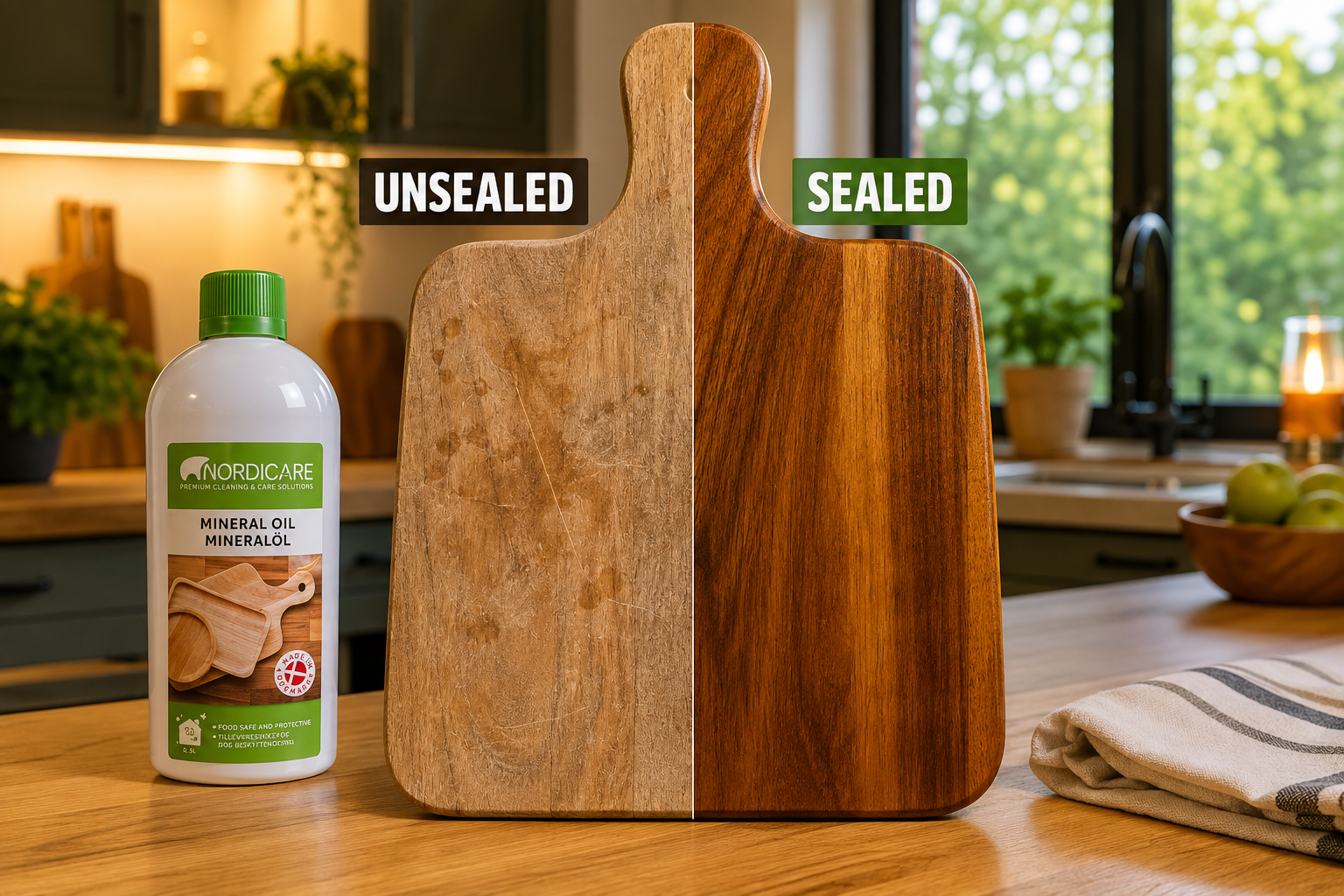
Mineral oil is used between those cleaning cycles. On open, absorbent timber it moves into the upper fibres, replacing some of what has been lost through washing. A board that had become pale and rough can regain a deeper tone and a smoother conditioned feel.
The centre of a board often dries before the edges because that is where most chopping and scrubbing happens. End grain can behave differently again and may absorb oil very quickly. A thick butcher block can show this particularly clearly.
You may also notice that water vanishes into worn parts of the surface almost immediately. After suitable oiling, small splashes are less likely to disappear straight into those dry fibres, although the board still needs prompt wiping and proper drying.
There is a hygiene point worth separating from the finish itself. Recent safefood research on Irish home kitchens found that only 25% of surveyed home cooks said they washed chopping boards every time after preparing raw food. Whatever treatment you use on the timber, food-safety cleaning should not be reduced to preserve the oil.
Wooden Worktops Islands and Breakfast Bars
Worktops usually wear in patches. The timber beside a sink is exposed to water and frequent wiping. A section near the hob may see grease, heat and repeated cleaning. A breakfast bar can spend most of its time under plates, cups and hands.
Those areas will not necessarily need maintenance at the same time.
Nordicare Mineral Oil makes sense on bare, absorbent worktops or timber already maintained with a compatible non-film oil. It can restore depth to wood that has become washed out through repeated cleaning without creating the shiny skin associated with varnish or lacquer.
The most useful approach is to judge the actual condition of each area. A dry strip by the sink may need attention while the rest of the worktop still looks well conditioned. Treating the entire surface on a fixed date can lead to unnecessary oil sitting on areas that are already saturated.
Keep ordinary spill management in place. Mineral oil can slow rapid absorption, but it does not make wood waterproof. Water, wine, juice and cooking residue should still be wiped up promptly. Around sinks and taps, sound joints and good sealing details matter far more than an extra coat of oil.
Home Kitchens and Higher-Use Food Environments
Usage changes the maintenance pattern. A serving board brought out occasionally for bread or cheese may stay in good condition for a long time. A timber preparation surface in a café, deli, cookery school or hospitality kitchen can be washed and wiped several times during one shift.
In a busy setting, inspection works better when it is attached to an existing routine. Staff can notice pale areas, roughness, staining or rapid water absorption while cleaning. Relying on an arbitrary re-oiling date can derail things.
Treatment also needs a suitable period of downtime. The surface has to be clean and dry before oiling and should remain out of food preparation until the excess has been removed and the product has had time to settle. That is easier to arrange during a closing routine than in the middle of service.
Commercial food-safety procedures still take priority. If a cleaning regime removes oil quickly, the answer is more frequent inspection and reconditioning when needed, not lighter cleaning.
What Nordicare Mineral Oil 500ml Does Inside the Wood
Penetration Instead of a Thick Surface Film
Wood may look solid, yet its structure contains cells, pores and pathways that still influence how liquids move after the timber has been cut and dried. A low-viscosity oil can enter those spaces instead of building a thick coating above them.
That is how Nordicare Mineral Oil works on suitable surfaces. Spread over clean, absorbent timber, it penetrates according to the wood’s porosity, grain direction and current condition. Dry areas usually take up more than sections that are already well maintained.
The result is quite different from varnish. You can still see and feel the grain because there is no hard plastic-like layer sitting over it. On a chopping board or butcher block, that natural surface feel is often part of the reason for choosing oil in the first place.
An intact film finish blocks this process. If varnish or lacquer already covers the wood, mineral oil has nowhere useful to go and can remain greasy on top.
Slowing Everyday Moisture Uptake
Wood is hygroscopic, so it exchanges moisture with the surrounding air. In a kitchen, direct wetting from washing and spills is added to those normal changes in humidity.
Mineral oil occupies part of the absorbent surface structure. Dry fibres are then less ready to take up a splash immediately. On a chopping board, that extra few moments can be useful because water or coloured food residue has less opportunity to sink straight into a depleted patch before it is wiped away.
The effect has limits. A board left in a wet sink can still absorb water. A worktop with water pooling around a failing sink joint can still swell, stain or move. Oil does not turn timber into a waterproof material and cannot compensate for persistent dampness.
For day-to-day care, the combination matters: keep the wood conditioned, wipe spills promptly and let boards dry with air reaching both faces.
Bringing Back Grain and Natural Colour
A dry wooden surface often looks dull or chalky because light is scattered differently by the depleted upper fibres. Once mineral oil penetrates those fibres, the grain usually appears clearer and the natural colour deepens.
The change varies with the timber. Darker species such as walnut can show a stronger shift than pale maple. End grain may deepen faster because it absorbs readily.
For a valued worktop, a small patch test is worth doing before treating the whole area. The oil is not a stain, but it can noticeably enrich the existing colour. A discreet test tells you how strong that change is likely to be on your particular piece of timber.
How to Know Whether Your Surface Is Suitable
Bare Wood and Previously Oiled Wood
Mineral oil needs access to the wood. Unfinished chopping boards, bare timber and surfaces already maintained with a compatible penetrating oil are the most straightforward candidates.
Dry open wood often gives itself away. It may turn darker almost instantly when dampened and fade again as it dries. The surface can feel slightly fuzzy after washing, and worn areas may absorb moisture faster than the edges.
Previously oiled timber often shows a different pattern. Areas that get the most handling or cleaning become paler first, while sheltered sections retain more depth. A small amount of oil may disappear quickly into those worn places.
Worktops are harder to identify when you did not choose the original finish. A previous owner may have used wax, hardwax oil, Danish oil or another system. Installation paperwork, old tins or manufacturer instructions are more reliable than guessing from appearance alone. Compatibility matters, particularly if you may want to refinish the surface later.
Lacquered Varnished Painted and Sealed Surfaces
A film finish is designed to create a barrier above the timber. Varnish, lacquer and paint therefore prevent mineral oil from penetrating in the same way it does on bare wood.
On an intact coating, the oil can stay on the surface as smears or greasy patches. Dust sticks to it, fingerprints show and the timber beneath receives little benefit.
Clues include a continuous sheen, a smooth plastic-like feel or scratches that appear to lie within a clear layer above the grain. Painted wood is simpler to recognise. Mineral oil is not intended as a polish for those finishes.
A failing coating needs its own decision. Local repair, cleaning or complete refinishing may be appropriate depending on the extent of the damage. Oiling over a mixture of exposed wood and surviving varnish usually produces uneven colour because some areas absorb and others do not.
A water-drop test can also mislead if a coating is scratched. Water may enter at damaged points even though most of the film is still intact.
Different Woods and Different Absorption Rates
Species and grain direction make a noticeable difference to how much oil a surface accepts. Density, age, previous treatment and wear all matter too.
End grain tends to absorb quickly because the ends of the wood fibres are exposed. Face grain can be slower. A dry butcher block may take substantially more oil than a dense worktop that has been maintained regularly.
Take Nordicare’s stated coverage of 10 m² per 500 ml as a planning figure (not a quantity for you to force onto every surface). Real use depends on how absorbent the timber is. A thirsty section may need more; another part may need very little.
That variation is normal. Apply according to the response of the wood. It beats trying to make every square metre consume the same amount.
When Oiling Is Not the Right Fix
Mineral oil conditions sound timber. It does not repair structural damage.
Deep splits, loose joints, soft or rotten areas, persistent mould and major water damage need attention before oiling. The same applies to a varnished or lacquered surface that is breaking down.
A chopping board with a deep crack that traps food may be better replaced. A worktop with black staining or movement around a sink joint needs the source of moisture corrected first. Oiling those problems can improve the colour temporarily while leaving the underlying fault untouched.
Use the product when dryness is the problem. Damage deserves repair.
Preparing the Wood Before You Apply Oil
Start With a Properly Clean Surface
Oil spreads best over clean wood. Crumbs, grease, sticky residue and leftover cleaner interfere with even absorption, so remove them before treatment.
For a chopping board, wash with hot soapy water, rinse and leave it upright to dry thoroughly. Avoid soaking it in the sink. A dishwasher is generally unsuitable unless the board’s manufacturer has specifically designed the product for that treatment.
Worktops need a cleaning method compatible with their existing finish. Grease around the hob and sticky deposits in food-preparation areas should be removed fully. Corners, edges and the back of the worktop are easy places to miss.
The surface is ready for oil only when it is clean. Merely ‘looking clean’ doesn’t cut it. If your fingers still pick up tackiness or you can see greasy shadows, keep cleaning.
Give Washed Wood Time to Dry
A board can feel dry on top while moisture remains deeper in knife cuts and fibres. Oiling too soon after washing can produce patchy uptake.
Allow enough time for the timber to dry right through. At home, that may simply mean washing the board after use, standing it upright with air moving around both sides and treating it later, not immediately. A worktop needs the same patience around sinks and draining areas.
Nordicare Paraffin Oil is insoluble in water. Any moisture left in the surface can therefore interrupt how evenly the oil penetrates.
Touch and appearance are usually enough to judge this. Timber that still feels cool from washing or remains visibly darker in places is not ready yet.
Deal With Roughness Before Oiling
Repeated wetting can raise the grain. Older boards may also develop uneven wear from years of knife use.
On bare or previously oiled wood, very light sanding can improve a rough surface before oiling. For new timber, 150-grit abrasive is a practical final preparation point before treatment.
Keep sanding proportionate to the problem. There is no reason to resurface the whole board aggressively because of a small patch of raised grain. Work evenly, follow the grain where appropriate and avoid creating hollows around worn areas.
Dust removal matters afterwards. Vacuum when suitable, wipe using a method that leaves no residue, and allow the timber to dry again before applying oil.
Do not begin sanding an unknown film finish as part of routine oiling. First decide whether that coating is being repaired or removed completely.
Patch Test and Set Up the Work Area
A patch test is particularly useful on a worktop you have not treated before. Apply a small amount somewhere inconspicuous and watch two things: how quickly the oil disappears and how much the timber darkens.
Then gather clean lint-free or suitable microfibre cloths before opening the bottle. You need one for application and enough clean material to remove every trace of excess later.
Protect nearby painted surfaces, fabrics or flooring if drips are possible. Normal ventilation is appropriate, and children should be kept away from the bottle and freshly treated area.
Having a spare cloth within reach sounds minor until oil has worked into an edge or corner and the first cloth is already saturated.
How to Apply Nordicare Mineral Oil 500ml
Use Enough Oil to Wet the Surface Evenly
Begin with a modest amount. Spread a few drops or a small quantity across the timber with a clean cloth, aiming for an even wet appearance. Don’t go flooding the surface.
A chopping board can usually be handled one face at a time. On a large worktop, smaller sections are easier because you can see where the oil has been spread and where it is being absorbed.
Add more only when the cloth no longer leaves a continuous film or a dry patch takes up the first application almost immediately. Pools and heavy glossy areas show that you are applying faster than the surface can absorb.
Keeping the quantity controlled also reduces drips along vertical edges and makes the final wipe much quicker.
Work With the Grain and Watch How the Wood Responds
Overlapping passes help you cover the surface without missed strips. Following the grain is useful mainly because it gives the work a clear direction and keeps the application orderly.
Absorption tells you more than the clock at this stage. A pale patch may darken immediately and lose its wet sheen within seconds. End grain can drink the first pass while nearby face grain stays glossy. A heavily washed section beside a sink may behave very differently from the area under a bread bin.
Move excess from slow-absorbing areas towards drier ones. Add a little more where the oil genuinely disappears quickly. There is no benefit in making both areas equally wet if one has already taken all it needs.
This is one of the few parts of the job where watching the timber is more useful than following a fixed quantity.
Let the Wood Absorb What It Needs
After the surface has been wetted evenly, leave the oil to penetrate for at least 15 minutes on clean, dry absorbent wood. Check the label on your bottle as well in case the product instructions have been updated.
During that time, resist the urge to keep rubbing constantly. The differences in absorption become easier to see when the surface is left alone for a few minutes. Dry areas turn matt sooner; sections that have enough oil remain shiny for longer.
New, freshly sanded or very depleted wood may need another light application in the areas that absorb rapidly. A wet layer left sitting indefinitely is not useful, however. Mineral oil does not cure into a hard finish, so an overnight puddle simply gives you more excess to remove.
For reversible chopping boards, include the edges and, where appropriate, both faces. Balanced maintenance is helpful on boards that repeatedly go through wetting and drying cycles.
Remove Every Trace of Unabsorbed Excess
After the absorption period, wipe the surface thoroughly with a clean cloth. Turn or replace the cloth as it picks up oil so that you are removing the residue, not moving it around.
Buff until the timber feels conditioned, not slippery. Run clean fingertips lightly over the surface. Smears, oily fingerprints or a slick feel mean more wiping is needed.
This final stage matters because mineral oil is supposed to sit mainly within the timber. Excess left above the surface can attract lint, mark objects and make a chopping board unpleasant to handle.
Repeat Only When the Wood Still Looks Thirsty
Very dry timber sometimes needs another treatment. Freshly sanded boards can also absorb more on the first maintenance session than they will later.
Judge this after the first application has been absorbed and the surface excess removed. If pale areas still take up a tiny test amount immediately, another light pass may be worthwhile. If the whole surface has an even conditioned appearance and no longer absorbs readily, stop.
There is no useful target number of coats. A board that needs two passes is not better treated than one that needs only one.
Return the Surface to Normal Use Sensibly
Once the final buff is complete, leave the treated surface out of use for about an hour. Before food preparation starts again, the wood should feel dry to the touch and should not transfer oil to your hand or a clean cloth.
Follow any different timing printed on the bottle you have.
After that, normal washing and everyday use can resume. There is no special daily treatment required simply because the wood has been oiled.
Building Oiling Into a Maintenance Routine
Learn the Signs of Dry Wood
Colour often changes first. Walnut can become greyer and flatter; maple or beech may look pale or slightly chalky. The feel of the surface changes too. Raised fibres are easier to notice with your hand than by eye, especially on a frequently washed worktop.
End grain may become rough before the rest of a board. Busy sections can also lose their smoother feel while sheltered areas remain well conditioned.
Water during ordinary cleaning gives another clue. A droplet that darkens the timber almost immediately in one area suggests that the surface there is taking up moisture quickly. You do not need to leave water sitting on the board to test it.
Use several signs together. One faint patch after washing may disappear when the wood dries. A surface that is pale, rough and absorbing water rapidly is a much clearer indication that maintenance is due.
Go with Condition over Fixed Calendar
A monthly refresh can be a useful general reference for Nordicare Mineral Oil, but kitchens do not all place the same demands on wood.
A serving board used twice a month may stay conditioned well beyond that point. A café preparation block washed throughout the day may need checking far sooner. Even a single worktop can have a dry zone beside the sink while the breakfast-bar end remains fine.
Base treatment on condition. If the surface still looks even, feels smooth and does not soak up moisture immediately, adding more oil simply because the calendar says so can leave unnecessary residue.
For households that like keeping records, noting the date of treatment can help you see roughly how long the wood stays conditioned. It should remain a reference, not an automatic instruction to oil again.
Clean Gently Between Oil Treatments
Routine cleaning determines how quickly the oil is lost. On a domestic chopping board, hot soapy water followed by rinsing and thorough upright drying is a sound baseline. Prompt cleaning also stops food residue hardening in knife marks and grain.
Hygiene takes priority after raw meat, poultry, seafood or eggs. If the required cleaning removes some of the oil, recondition the timber sooner when it shows dryness. Preserving the finish is never a reason to under-clean a food-contact surface.
Worktops benefit from the same proportionate approach. Wipe spills as they happen and use cleaners suited to the finish and the soil present. Repeated use of strong degreasers can strip a penetrating oil faster than necessary.
Cleaning removes contamination. Oiling restores condition after that cleaning. They support each other, but they are not substitutes for one another.
Adjust the Routine for Busy Kitchens
In a higher-use kitchen, maintenance works best when responsibility is obvious. Someone should notice the condition of timber surfaces during normal cleaning and flag when treatment or repair is needed.
A closing check can be very simple: is the board clean and dry, are any sections becoming pale or fuzzy, and is there new staining, cracking or coating failure around the worktop? Dryness can be scheduled for oiling during downtime. Damage should be escalated. Don’t hide it under the oil.
Frequent washing usually means frequent inspection, not necessarily a fixed re-oiling interval. If your food-safety or maintenance system requires records, log the treatment. In a home kitchen, you can be less formal. Noticing the board as you put it away is often enough to catch the point when it starts looking tired.
Common Mineral Oil Mistakes and How to Avoid Them
Leaving Too Much Oil on the Surface
A greasy board usually has excess product sitting above the timber. Shiny patches, fingerprints, streaks and lint sticking to the surface are the obvious signs.
Stop adding oil. Buff with a clean cloth until the surface feels dry and smooth, not slick.
If the greasy patches return after thorough wiping, the wood may already be saturated or a previous finish may be blocking absorption. Recheck what is on the surface before applying anything else.
Oiling Wood That Is Still Damp
Water left in the fibres can interrupt mineral-oil absorption and give an uneven result. A board may end up darker in one place, pale in another, with oil sitting on top of an area that had only appeared dry.
Prevention is easier. Wash first and give the timber enough airflow and time to dry fully.
If oil has already been applied to damp wood, remove all visible excess and let the surface dry. Reassess it once the timber is clean and dry. Don’t go correcting the patchiness by pouring on more product.
Using Aggressive Cleaning Methods After Oiling
Oil does not make a wooden board immune to poor cleaning habits. Prolonged soaking, dishwashers, excessive heat and unnecessarily harsh degreasers can remove oil quickly and increase the stress from repeated wetting and drying.
Use a cleaning method suited to the food risk. For household wooden chopping boards, safefood recommends hot soapy water, rinsing and upright drying over soaking or dishwashing.
In kitchens that require more intensive cleaning, accept that the timber will need checking more often. Leaving a thicker layer of mineral oil on the surface after treatment is not a substitute for reconditioning when necessary.
Mixing Mineral Oil With an Unknown Existing Finish
Worktops are often the problem here, particularly in homes where the original finishing product is no longer known.
A glossy or sealed surface may already have varnish, lacquer or another coating. Mineral oil cannot condition the underlying timber properly through an intact film and can leave greasy patches on top. Mixing systems can also complicate future refinishing.
Check maintenance information, old product tins or the manufacturer’s instructions where possible. If you are still unsure, test a small inconspicuous area and investigate before treating the entire worktop.
Water beading alone is not enough to identify the finish. Scratches and worn points can absorb even while most of a coating remains intact.
Expecting Oil to Repair Damage
Mineral oil can make dry timber look richer, and that sometimes makes existing damage less obvious for a while. The damage itself is unchanged.
A crack remains a crack. A burn mark is still scorched wood. A loose glue joint still needs repair. Black staining near a sink may point to long-term moisture exposure. It’s not always simple dryness.
Light knife scoring can sometimes be dealt with by resurfacing a chopping board. Deep cracks that trap food may make replacement the safer choice. Soft or rotten timber needs proper repair.
Nordicare Mineral Oil 500ml is most useful when the wood is sound and simply losing condition through normal use. Clean it properly, let it dry, apply only what it can absorb and wipe the excess away. From there, the surface itself tells you when it is time to do it again.
Recommended products
Discover more alternatives and similar items.
_3nd-300x300.jpeg)